

 UK
 EN


Аль-Саммак Наджлаа Ібрагім1
 Худер Хана Абдул-Кадер2
Джасім Шаймаа А.Х.2
Ключові слова: рівні стресу, булінг, кореляти стресу, взаємозв’язок між стресом і здоров’ям, стратегії подолання стресу, стрес у населення Мосула (Ірак)
Key words: stress levels, bullying, correlates of stress, relation between stress and health, coping strategies for stress, stress in Mosul/Iraq
Реферат
Стрес є однією з поширених проблем сучасного життя. Він впливає на людей у всьому світі, особливо в регіонах з економічною та політичною нестабільністю, зокрема в Іраку. Щоденні стресові чинники змушують мешканців таких районів переживати сильний стрес, що негативно позначається на їхньому здоров’ї. Відтак, метою цього дослідження було оцінити рівень стресу, пов’язані з ним проблеми зі здоров’ям та стратегії подолання стресу серед населення Мосула (Північний Ірак). Протягом чотирьох місяців було проведено перехресне опитування 553 дорослих осіб. Для вимірювання рівня стресу використовувалася шкала PSS-10. Зібрані дані включали соціально-демографічну інформацію, відомості про звички та стан здоров’я кожного учасника, а також інформацію про методи, які вони застосовували для подолання стресу. У роботі використовувалися методи описової та аналітичної статистики, зокрема розрахунок середніх значень і стандартного відхилення (SD), F-критерій, критерій хі-квадрат, точний критерій Фішера та порядкова логістична регресія. Встановлено, що переважна більшість (>85%) учасників страждала від стресу середнього або високого рівня; при цьому вищі показники стресу спостерігалися серед молоді, жінок, неодружених, студентів, а також осіб з незадовільними сімейними стосунками та тих, хто зазнавав цькування (булінгу) і не мав належного захисту (значення p у діапазоні 0,005-<0,001). Учасники оцінювали стан свого здоров’я як незадовільний, скаржачись на втому, головний біль, тривожність, депресію, порушення сну та проблеми з пам’яттю (p<0,001). Хоча учасники рідко вдавалися до стратегій подолання стресу, результати регресійного аналізу показали, що найефективнішими методами, які допомагали підтримувати низький рівень стресу, були молитва, медитація, відпочинок і тимчасове дистанціювання від стресових подій (значення p у діапазоні 0,041-0,002). Отже, дослідження виявило тривожно високий рівень стресу серед мешканців Мосула, що негативно впливає на їхнє здоров’я та повсякденне життя. До заходів, які, згідно з результатами аналізу, сприяють зниженню рівня стресу, належать молитва, медитація, відпочинок та уникнення стресових чинників.
Abstract
Correlates and associated factors of stress, a cross-sectional analysis of the relation between stress and human health. Al-Sammak Najlaa Ibrahim, Khuder Hana Abdul-Qader, Jasim Shaymaa A.H. Stress is one of the pervasive problems of modern life. It affects individuals everywhere in the world specifically the economically and politically unstable areas including Iraq. The daily-life stressors make people in such areas agonize high stress that affect their health adversely. Hence, this study aims to measure stress, its related health issues, and coping strategies for people in Mosul/ Northern Iraq. A cross-sectional survey was performed among 553 adults over a period of 4 months. The questionnaire form was applied depending on PSS 10 for stress measurement. Data involved socio-demographic, habitual, and health related information for each participant, in addition to their coping activities to overcome stress. Descriptive and analytic statistics were used including means, SD, F-test, Chi-square, Fisher-Exact tests, and Ordinal logistic regression analysis. It was found that, the vast majority (>85%) of participants suffered from moderate to high stress, more significantly among young, female, unmarried, students, with poor familial relationships, and bullying unprotected participants (p-value ranges 0.005-<0.001). They perceived their health as poor and complaining from fatigue, headache, anxiety, depression, sleep disturbances, and amnesia (p<0.001). All coping strategies were performed infrequently by participants, but the most operative methods that kept people under low stress were praying, meditation, taking rest, and temporarily distancing from stressful events as predicted by regression analysis (p-value ranges 0.041-0.002). So, this study reveals alarming levels of stress among residents of Mosul which adversely affecting their health and daily living. Activities that are predicted to lower stress involved praying, meditation, taking rest, and avoiding stressors.
Stress is an inevitable natural psychological and physiological response of the human body to internal and external threats or demands known as stressors [1, 2]. Exposure to acute problems can be overwhelmed effectively in form of adaptive human responses; however, repeated or prolonged stressors can threaten health and contribute to serious illnesses [3]. Stress can be influenced by various reasons including individual factors such as genetics, personality trait, and coping capabilities; environmental factors like socio-economic status, life events, and workplace pressures; and social factors as social inequity and relationship difficulties [4, 5, 6]. Physiologically, chronic stressors promote the hypothalamic-pituitary-adrenal axis leading to sustainable release of the stress hormone ‘cortisol’ which can damage body systems on prolonged elevation [7].
The effects of stress on human health are ranged from short-term problems such as headache, fatigue, insomnia, and anxiety, to chronic serious conditions as cardiovascular diseases (CVDs), immune dysfunction, diabetes mellitus (DM), and psychological problems like post-traumatic distress syndrome (PTSD), depression, cognitive impairment, and reduced learning capabilities [8, 9, 10]. Additionally, stress affects negatively work performance and social relationships worsening life quality and hastening aging process [11, 12].
Stress releasing strategies deliver potential interventions that improve well-being in highly stressed environments. Among the governmental interventions that achieve decent standard living for all citizens are equal opportunities for education, health services, job provision, workplace interventions, socioeconomic improvement, and community-based supportive initiations [13, 14]. Other stress coping activities can be achieved at individual level such as physical activities, engaging in mindfulness rituals like praying and meditation, seeking social support, and experiencing healthy living as adequate nutrition and proper sleep [15, 16].
Stress is a part of our daily life, particularly in conflict-affected regions such as the Middle East, where political and economic instability exacerbate mental strain. Iraq, the central part of this region, was suffering for decades from different forms of wars, blockade, terrorism, and occupation that harvested hundred thousand of population’s lives and destroyed the infrastructures. People in Mosul City, who agonized additionally ISIS occupation for more than three years, still suffered from the sequences of these events with high levels of stress, anxiety, and depression which are ultimately responsible for the uppermost levels of suicidal thoughts and attempts [17]. Most researches in Mosul focused on the psychological disorders without exhibiting stress and its related factors. Accordingly, this study aimed to demonstrate the extent to which population agonized stress, its correlates, associations with health problems, and the main valuable coping activities that mitigate stress and promote overall wellbeing.
MATERIALS AND METHODS OF RESEARCH
In accordance with the Declaration of Helsinki, the study was approved by the "Scientific Committee and Medical Research Ethics Committee in the College of Medicine/ University of Mosul" with the number: UOM/COM/MREC/24-25/DEC".
Research’s objectives and benefits were explained to participants prior to data collection, and they were invited to share their data after obtaining their informed consents. Confidentiality and anonymity of participants’ information were assured with emphasis on their ability to withdraw from the study without any consequences.
A cross-sectional study was performed among adult population in Mosul City/ Northern Iraq to examine the factors that are associated with stress and its coping strategies. The study involved adults of both sexes and from various socio-demographic and cultural backgrounds. Data were collected from public places such as markets, universities which involve in addition to colleges, restaurants, libraries, and book stores, their clients are mix of students, employers, and other people with various social, educational, and economic backgrounds who are representative to the general population of the city.
Study’s participants involved adults that were chosen conveniently from colleges and public places over a period of 4 months starting from Sep. 2025 excluding people with severe mental problems. To calculate sample size, Cochrane formula was used: [n= (Z^2 pq)/d^2] [18]. The prevalence of stress in the city is unknown; so, we use p=50%. Consequently, the calculated sample was 384, but the total distributed questionnaire forms were 600 taken in consideration any missing data. So, the final sample was 553 with 92.2% completion rate.
Both direct interviews and self-administered information gathering were adopted for data collection depending on participants’ preferences. The questionnaire form included detailed socio-demographic, habitual, and health status information about each participant to identify the relation between these factors and stress. It was validated by presenting research’s protocol to the "Scientific Committee of Specialists in Family Medicine and Community Medicine in the College of Medicine", and gained reliability by test-retest pilot study on 50 participants with Cronbach’s α =79% [18].
To measure stress level, the Arabic validated version of Perceived Stress Scales (PSS 10) was used due to its appropriateness to the study population. It involves 10 questions with 5 answers for each according to the 5-points Likert’s scale: (never=0, rarely=1, sometimes=2, often=3, and always=4) [19]; so, the total scores were ranged between 0-40. Consequently, participants were divided into three groups depending on their answers: (low stress =0-13, moderate stress =14-26, and high stress =27-40) [19]. Comparisons between these three groups were performed to identify the association between various variables and stress symptom scores. Another group of questions involved data about the health problems as perceived by the study participants and their adopted activities to cope with and overcome stress.
Research’s data were arranged in Excel sheet and then analysed by SPSS version 26 "IBM Corp., Chicago, USA; license number:
WHIQVZYWLARL9JEYQEGDUBLH8Z3ZCJAL3FLXMS98V95TSDYI7FOEXUPRR".
Descriptive data were displayed as frequencies, percentages, means, and SD, in addition to calculating crowding index as (no. of persons/no. of rooms), and BMI (weight in kg/height in m2). The Q-Q plots and histograms were used to assess the normal distribution of continuous variables.
Questions about strategies of overcoming stress involved 5 answers ranging from never=1 to always=5; thus, the preferable mean answer was ≥ 3, any mean answer <3 means infrequent performance of the coping activity by the study contributors.
The association between stress and human health was determined by comparing the variables among the three study groups using ANOVA analysis for means (as the variables are normally distributed), Chi-square and Fisher-Exact tests for categorial variables, and ordinal logistic regression for predictors, their significance level was <5% [18].
RESULTS AND DISCUSSION
Study participants were divided into three groups depending on their stress scale: low stress in 81 (14.7%), moderate stress in 386 (69.8%), and high stress in 86 (15.5%). It is obvious that the majority of people suffered from moderate to high stress symptom score.
The association between socio-demographic and habitual factors with stress
Among the sociodemographic factors that significantly associated with high stress are young age 18-25 years (p=0.001), female gender (p<0.001), unmarried status (p=0.005), students; having poor familial and social relationships; exposing to bullying (p<0.001 each), having mean crowding index of 1.65 (p=0.033), and mean BMI of 25.7 (p=0.022). Moreover, the relevant habitual factors include lack of physical exercise (p=0.001) and lack of smoking (p=0.007) as demonstrated in Table 1.
Stressors, whether positive or negative, have unavoidable mental and physical effects on human that is ranging from short-term problems to chronic diseases upon continuous exposure. Living in an area suffered from high levels of political and economic instability, as in Iraq, make people more vulnerable to chronic stress and its consequences. This study revealed that 85.3% of population in Mosul suffer from moderate to high levels of stress, mostly among students just similar to the finding of Ibrahim et al. [20] among students in Sudan as they live under the same circumstances as Iraqi people.
The most significant correlates of high stress were young age (p=0.001), female gender (p<0.001) “which was proved by regression analysis”, unmarried status (p=0.005) reflecting the lack of social support, students (p<0.001) owing to learning’s difficulties, poor familial and social relationships (p<0.001), bullying exposure (p<0.001), with mean crowding index of 1.65 (p=0.033), and mean BMI of 25.7 (p=0.022). In Bangladesh, comparable relations of psychological problems including stress were exhibited among university students especially those aged 21–23 years, female, unmarried, and having small family size [21], whereas the relation between normal BMI with stress may be confounded by the young age and student status of participants in the current study.
Lack of physical exercise (p=0.001) and lack of smoking (p=0.007) were the main habitual factors related to high stress. Committing physical activities has direct effect on mood enhancement and stress cessation [22] and this was supported by regression analysis, but smoking was not proved by regression as relieving factor and may be confounded by the young age of participants. This relation was contradicted by Lawless et al. [23] but matched with a multinational study in 41 countries which revealed a positive relation between heavy smoking and high stress levels [24]. Both smoking and BMI vary considerably across age groups; therefore, the young age of participants may confound their observed relation with stress, and longitudinal studies are needed to clarify such relationship.
Socio-demographic and Habitual Factors Stress level p-value* low stress (n=81) moderate stress (n=386) high stress (n=86) No. % No. % No. % Age (years) 18-25 24 29.6 109 28.2 44 51.2 0.001 26-40 25 30.9 136 35.3 23 26.7 ≥41 32 39.5 141 36.5 19 22.1 Sex Male 42 51.9 122 31.6 11 12.8 <0.001 Female 39 48.1 264 68.4 75 87.2 Residence Urban 75 92.6 373 96.6 80 93.0 0.111** Rural 6 7.4 13 3.4 6 7.0 Education level <University level 7 8.6 18 4.7 6 7.0 0.250** University and higher education 74 91.4 368 95.3 80 93.0 Marital status Single 33 40.7 155 40.2 51 59.3 0.005 Married/ Divorced/ Widowed 48 59.3 231 59.8 35 40.7 Social class Low 1 1.2 5 1.3 1 1.2 0.095** Middle 28 34.6 166 43.0 47 54.7 High 52 64.2 215 55.7 38 44.1 Job Student 22 27.2 99 25.6 44 51.1 <0.001 Employed 39 48.1 241 62.5 36 41.9 Free jobs/ Retired‡ 16 19.8 26 6.7 2 2.3 Housewife 4 4.9 20 5.2 4 4.7 Housing Owned 71 87.7 340 88.1 73 84.9 0.719 Rented 10 12.3 46 11.9 13 15.1 Family type Nuclear 69 85.2 326 84.5 68 79.1 0.439 Extended 12 14.8 60 15.5 18 20.9 Poor familial and social relationships Never/ Rarely 52 64.2 107 27.7 33 38.4 <0.001 Sometimes 23 28.4 195 50.5 26 30.2 Often/ always 6 7.4 84 21.8 27 31.4 Exposure to bullying Never/ Rarely 44 54.3 95 24.6 18 20.9 <0.001 Sometimes 21 25.9 188 48.7 46 53.5 Often/ always 16 19.8 103 26.7 22 25.6 Exercise Never/ Rarely 37 45.6 233 60.3 61 70.9 0.001 Sometimes 22 27.2 103 26.7 18 20.9 Often/ always 22 27.2 50 13.0 7 8.2 Smoking Never/ Rarely 65 80.2 314 81.4 82 95.3 0.007** Sometimes 2 2.5 19 4.9 0 0.0 Often/ Always 14 17.3 53 13.7 4 4.7 Sedative drugs’ use Never/ Rarely 70 96.3 332 86.1 73 84.9 0.088** Sometimes 2 2.5 38 9.8 8 9.3 Often/ Always 1 1.2 16 4.1 5 5.8 Mean crowding index 1.52±0.684 1.41±0.759 1.65±1.045 0.033*** Mean BMI (kg/m2) 27.06±4.626 27.59±6.206 25.70±4.380 0.022*** Notes: *Chi-square test; **Fisher-Exact test; ***One-way ANOVA; Sig. level <0.05; ‡ Involving non-employers and retired people.
The association between chronic diseases and stress
Table 2 explores the association between chronic diseases and stress. It was found that more than one third (205/37.1%) of all participants had at least one chronic disease. Although highly stressed participants significantly perceived their health status as fair or poor (p<0.001); however, clarifying these diseases separately reveals non-significant differences among the three study groups.
The relation between chronic diseases and stress is complex and acting in a vicious circle as prolonged stress can lead to chronic diseases and vice versa. More than one third (37.1%) of all participants had one or more chronic diseases. Although no significant association was found between the presence of chronic diseases and stress levels, participants with high stress levels were significantly more likely to report poor health (p<0.001). A similar adverse effect of chronic diseases on population’s psych, body, and social relationships has been demonstrated in Africa and other world places [25, 26].
Chronic Diseases Stress level p-value* low stress (n=25) moderate stress (n=148) high stress (n=32) No. % No. % No. % Cardiovascular diseases 2 2.5 9 2.3 4 4.7 0.450** Diabetes mellitus 7 8.6 24 6.2 3 3.5 0.387 Hypertension 6 7.4 33 8.5 4 4.7 0.470 Respiratory diseases 1 1.2 14 3.6 3 3.5 0.699** Osteoarthritis 5 6.2 33 8.5 11 12.8 0.299 Renal problems 0 0.0 12 3.1 3 3.5 0.273** GIT/ Peptic ulcer 1 1.2 17 4.4 7 8.1 0.105** Migraine 3 3.7 38 9.8 6 7.0 0.166 Others (psychological/ disabilities) 3 3.7 43 11.1 14 16.3 0.030 Overall health status (participants’ perception) Good 53 65.5 128 33.2 15 17.4 <0.001 Average 27 33.3 229 59.3 51 59.3 Poor 1 1.2 29 7.5 20 23.3 Notes: *Chi-square test; **Fisher-Exact test; Sig. level <0.05.
The association between stress and health
Of all participants, 534 (96.6%) claimed that they were complaining from one or more health problems in the last month prior to data collection. It is clear that, apart from elevated blood pressure, all health problems are perceived more prominently by the highly stressed people (p<0.001) as displayed in Figure. Mostly, they suffered from fatigue, headache, anxiety, depression, sleep disturbances, and amnesia.
It is evident that stress influences human health adversely. The vast majority of participants (96.6%) were complaining from one or more health issues regardless their stress level; however, all health problems, except elevated BP, were significantly more prominent in the highly stressed group (p<0.001) specifically fatigue, headache, anxiety, depression, sleep disturbances, and amnesia. Comparable results were explored by several studies globally in America, Europe, and Asia [27, 28, 29]. This is logical because stressors negatively affect immune system and cause elevation of stress hormones like cortisol all of which increasing health problems and complaints among highly stressed people.
*Chi-square test, Sig. level <0.05 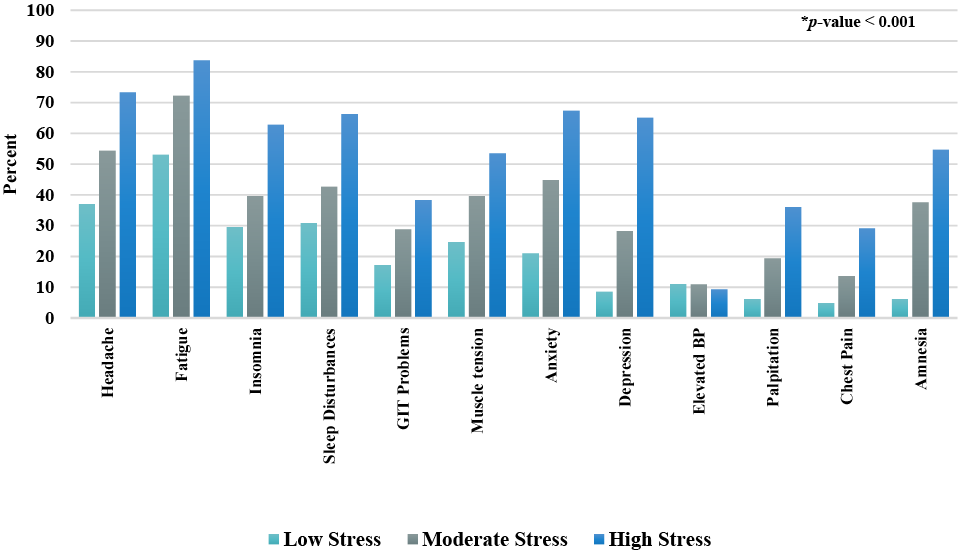
Strategies of overcoming stress and aggravating and relieving predictors of stress
Table 3 shows the main activities that were performed by the study participants to cope with stress. In general, all activities, apart from praying, were performed infrequently among most participants regardless their stress level. However, it is obvious that sleeping enough, eating balanced diet, and keeping isolated from stressful events are important factors to preserve people at lower stress symptom scores (means=3.11, 2.98, and 3.33 respectively). Alternatively, seeking social support and taking time off from work or study are significantly more prominent among highly stressed group (p=0.007 and 0.015 respectively), but they still under the desired level of overcoming stress.
Ordinal logistic regression of the variables associated with stress
Among all study variables, Table 4 exhibits the main predictors that are associated with stress whether in an aggravating or reliving manner. For demographic factors, females and those who have lacked exercise in their daily activities appear to be significantly more prone to have stress (p<0.001 and 0.018 respectively), the same for people suffering from psychological problems or disabilities (p=0.004). Moreover, the main significant coping strategies that are predicted to be effective in keeping people at lower stress levels are praying, meditation or relaxation, taking time off work or school to recharge, and keeping isolated from stressful events (p-value ranges 0.041-0.002).
While stress is an inevitable daily life event that may harmfully impact our psychе and body, coping activities ought to be part of our lifestyle to ameliorate stress and continue with a relatively healthy existence. Several approved strategies are present to overcome stress, most of them were adopted infrequently by study participants leading to imperceptible effect on stress reduction. Praying, meditation or relaxation, taking time off from work or study, and temporary distancing from stressful events appeared to be significant predictors of having lower stress levels.
Activities Stress level p-value* low stress (n=81) moderate stress (n=386) high stress (n=86) mean±SD mean±SD mean±SD Engage in activities to manage stress (e.g. hobbies, socializing) 2.44±1.173 2.75±1.059 2.52±1.176 0.027 Seek social support from friends / family 2.19±1.174 2.56±1.026 2.66±1.123 0.007 Seek professional help e.g. therapy, counselling 1.47±0.760 1.65±0.889 1.49±0.917 0.115 Use sedatives / medications 1.26±0.738 1.41±0.779 1.48±0.891 0.178 Perform religious acts as praying 3.63±1.156 3.89±1.007 3.99±1.090 0.061 Practice mindfulness / meditation / or relaxation 1.94±1.053 1.95±0.963 1.80±1.206 0.459 Make recreational activities 2.51±1.038 2.80±0.967 2.51±1.234 0.009 Practice sports or other physical activities 2.28±1.143 2.21±1.048 1.90±1.096 0.028 Take time off work or school to recharge 2.09±0.990 2.45±1.019 2.49±1.361 0.015 Sleep enough 3.11±1.162 2.99±0.972 2.84±1.216 0.230 Eat balanced food 2.98±1.151 2.71±0.991 2.41±1.056 0.002 Temporary distancing from stressors 3.33±1.037 3.15±0.993 2.60±1.151 <0.001 Notes: * – оne-way ANOVA; Sig. level <0.05; average score for each activity =3; <3 – poor score; ≥3 – good score.
Undoubtedly, praying and meditation have ameliorating effects on stress and its related health problems owed to released tension, enhanced mood, and improved sleep [30]. Equally, taking rest and avoiding stressors temporarily have tension releasing effects especially under unsettled life events [31, 32].
In general, the alarming levels of stress in the current study require targeted interventions by increasing population awareness toward utilizing mental health services without feeling shame and implementing mental health screening programs among attendees of primary health clinics.
Variables β Adjusted OR SE p-value 95% CI for adjusted OR Gender Male -1.245 0.29 0.257 <0.001 0.17-0.48 Female (Ref.) ---- 1.00 ---- ---- ---- Exercise Never 0.704 2.02 0.297 0.018 1.13-3.61 Sometimes 0.437 1.55 0.320 0.172 0.83-2.90 Often (Ref.) ---- 1.00 ---- ---- ---- Chronic diseases (Psychological / disability) Absent -0.865 0.42 0.297 0.004 0.24-0.75 Present (Ref.) ---- 1.00 ---- ---- ---- Coping strategies: Perform religious acts as praying Never -1.204 0.30 0.656 0.066 0.08-1.09 Rarely -1.004 0.37 0.408 0.014 0.16-0.82 Sometimes -0.592 0.55 0.290 0.041 0.31-0.98 Often -0.691 0.50 0.254 0.007 0.30-0.82 Always (Ref.) ---- 1.00 ---- ---- ---- Practice mindfulness / meditation / or relaxation Never -2.069 0.13 0.816 0.011 0.03-0.62 Rarely -2.544 0.08 0.837 0.002 0.02-0.40 Sometimes -2.413 0.09 0.838 0.004 0.02-0.46 Often -2.562 0.08 0.894 0.004 0.01-0.45 Always (Ref.) ---- 1.00 ---- ---- ---- Take time off work or school to recharge Never -1.740 0.18 0.557 0.002 0.06-0.52 Rarely -1.625 0.20 0.561 0.004 0.07-0.59 Sometimes -1.508 0.22 0.557 0.007 0.07-0.66 Often -0.929 0.39 0.594 0.118 0.12-1.26 Always (Ref.) ---- 1.00 ---- ---- ---- Temporary distancing from stressors Never 1.640 5.16 0.563 0.004 1.71-15.55 Rarely 1.134 3.11 0.469 0.016 1.24-7.79 Sometimes 0.249 1.28 0.434 0.567 0.55-3.00 Often -0.072 0.93 0.433 0.868 0.40-2.17 Always (Ref.) ---- 1.00 ---- ---- ---- Notes: β= regression coefficient; SE= standard error; OR= odds ratio; CI= confidence interval, Ref.= reference category, Sig. level <0.05.
Limitations of the study. Among the most important limitations was the convenience sampling technique that may affect the generalizability of results, this was overcome to some extent by involving larger number of participants than estimated. Additionally, the cross-sectional design can’t identify causality and temporal relationship for the underlying health problem and coping strategies; accordingly, future longitudinal studies are recommended for accurate estimation of such relationships.
CONCLUSIONS
- Stress affects most people in Mosul especially the young, unmarried, female, students, with poor social relationships, and bullying unprotected participants.
- Highly stressed people perceived their health as poor and complained frequently from fatigue, headache, anxiety, depression, sleep disturbances, and amnesia.
- Helpful activities that were declared by people to lower stress involved praying, meditation or relaxation, taking rest, and avoiding stressors. Addressing these issues aids in tailoring targeted health interventions with broadening mental health awareness and services among population.
Acknowledgement. To all participants who explored their conflicts and suffering.
Contributors:
Al-Sammak Najlaa Ibrahim – conceptualization, project administration, methodology, formal analysis, software, and writing – review & editing;
Khuder Hana Abdul-Qader – investigation, data collection and funding;
Jasim Shaymaa A.H. – investigation, data collection and funding.
Funding. This research received no external funding.
Conflict of interests. The authors declare no conflict of interest.
REFERENCES
- World Health Organization. Stress [Internet]. Geneva: World Health Organization; 2023 [cited 2026 May 11].Available from: https://www.who.int/news-room/questions-and-answers/item/stress
- American Psychological Association. Stress [Internet]. APA Dictionary of Psychology; 2023 [cited 2026 May 11].Available from: https://dictionary.apa.org/stress
- Ali N, Strahler J, Nater UM. The effects of chronic fatigue and chronic stress on alterations in immune cell responses to acute psychosocial stress. Brain Behav Immun.2025;123:707-16. doi: https://doi.org/10.1016/j.bbi.2024.10.013
- Ajay A, Tharakan A, Sreedevi A, Lalithambika CV. Assessing Post-traumatic Stress Disorder and Social Determinants Among COVID-19 Case-Contact Dyads in Household Settings. Cureus. 2024;16(9):e68425. doi: https://doi.org/10.7759/cureus.68425
- McEwen BS, Gianaros PJ. Central role of the brain in stress and adaptation: links to socioeconomic status, health, and disease. Ann N Y Acad Sci. 2010;1186:190-222. doi: https://doi.org/10.1111/j.1749-6632.2009.05331.x
- Castarlenas E, Galán S, Solé E, Roy R, Sánchez-Rodríguez E, Jensen MP, et al. Perceived stress, perceived social support, and global health in adults with chronic pain.IntJ Behav 2025;32(1):92-101. doi: https://doi.org/10.1007/s12529-023-10250-6
- Knezevic E, Nenic K, Milanovic V, Knezevic NN. The role of cortisol in chronic stress, neurodegenerativediseases, and psychological disorders. Cells. 2023;12(23):2726. doi: https://doi.org/10.3390/cells12232726
- Rulu P, Bertone-Johnson ER, Kamilar J, Dhall M, Sievert LL. Chronic stress, social support, and symptoms at midlife. Is there a buffering effect? Am J Biol Anthropol. 2024;184(2):e24936. doi: https://doi.org/10.1002/ajpa.24936
- Ortega MA, García-Montero C, Fraile-Martinez O. Immune-Mediated Diseases from the Point of View of Psycho-neuro-immuno-endocrinology. Biology (Basel).2022;11(7):973. doi: https://doi.org/10.3390/biology11070973
- Ghasemi F, Beversdorf DQ, Herman KC. Stress and stress responses: A narrative literature review from physiological mechanisms to intervention approaches. J PacRim 2024;18:1-15. doi: https://doi.org/10.1177/18344909241289222
- Dougall I, Vasiljevic M, Kutlaca M, Weick M. Socioeconomic inequalities in mental health and wellbeing among UK students during the COVID-19 pandemic: Clarifying underlying mechanisms. PloS One.2023;18(11):e0292842. doi: https://doi.org/10.1371/journal.pone.0292842
- Shalev I, Entringer S, Wadhwa PD, Wolkowitz OM, Puterman E, Lin J, et al. Stress and telomere biology: a lifespan perspective. Psychoneuroendocrinology.2013;38(9):1835-42. doi: https://doi.org/10.1016/j.psyneuen.2013.03.010
- Piao X, Xie J, Managi S. Continuous worsening of population emotional stress globally: Universality and variations. BMC Public Health. 2024;24:3576. doi: https://doi.org/10.1186/s12889-024-20961-4
- Alkhawaldeh JM, Soh KL, Mukhtar F, Peng OC, Alkhawaldeh HM, Al-Amer R, et al. Stress management training program for stress reduction and coping improvement in public health nurses: A randomized controlled trial.JAdv 2020;76(11):3123-35. doi: https://doi.org/10.1111/jan.14506
- Dong Y, Zhang X, Zhao R, Cao L, Kuang X, Yao J. The effects of mind-body exercise on anxiety and depression in older adults: a systematic review and networkmeta-analysis. Front Psychiatry. 2024;15:1305295. doi: https://doi.org/10.3389/fpsyt.2024.1305295
- Finkel A, Fougea G, Roux S. An automata-based method to formalize psychological theories: the case study of Lazarus and Folkman's stress theory. In: Proceedings of the 13th International Conference on Model-Based Software and Systems Engineering (MODELSWARD 2025). Setúbal:SCITEPRESS; p. 204-15. doi: https://doi.org/10.5220/0013175400003896
- Al-Sammak NI, Al-Hamdany AF. Assessment of factors influencing suicidal thoughts and attempts among population in Mosul. Int J Soc Psychiatry. 2025;71(5):894-901. doi: https://doi.org/10.1177/00207640241311847
- Daniel WW, Cross CL. Biostatistics: A foundation for analysis in the health sciences. 11th ed. Hoboken (NJ):John Wiley & Sons; 2018. Available from: https://www.wiley.com/enus/Biostatistics%3A+A+Foundation+for+Analysis+in+the+Health+Sciences%2C+11th+Edition-p-9781119496571
- Chaaya M, Osman H, Naassan G, Mahfoud Z. Validation of the Arabic version of the Cohen Perceived Stress Scale (PSS-10) among pregnant and postpartum women.BMC 2010;10:111. doi: https://doi.org/10.1186/1471-244X-10-111
- Ibrahim D, Ahmed RM, Mohammad AZ, Ibrahim B, Mohammed T, Mohamed ME, et al. Prevalence and correlates of generalized anxiety disorder and perceived stress among Sudanese medical students. BMC Psychiatry.2024;24(1):68. doi: https://doi.org/10.1186/s12888-024-05510-y
- Kamruzzaman M, Hossain A, Islam MA, Ahmed MS, Kabir E, Khan MN. Exploring the prevalence of depression, anxiety, and stress among university students in Bangladesh and their determinants. Clin Epidemiol Glob Health.2024;28:101677. doi: https://doi.org/10.1016/j.cegh.2024.101677
- Zureigat H, Osborne MT, Abohashem S, Mezue K, Gharios C, Grewal S, et al. Effect of stress-related neural pathways on the cardiovascular benefit of physical activity. J Am Coll Cardiol. 2024;83(16):1543-53. doi: https://doi.org/10.1016/j.jacc.2024.02.029
- Lawless MH, Harrison KA, Grandits GA, Eberly LE, Allen SS. Perceived stress and smoking-related behaviors and symptomatology in male and female smokers.Addict 2015;51:80-3. doi: https://doi.org/10.1016/j.addbeh.2015.07.011
- Stubbs B, Veronese N, Vancampfort D, Prina AM, Lin PY, Tseng PT, et al. Perceived stress and smoking across 41 countries: A global perspective across Europe, Africa, Asia and the Americas. Sci Rep. 2017;7(1):7597. doi: https://doi.org/10.1038/s41598-017-07579-w
- Bakzaza B, Lemmih H, Errachidi F, El Bouazzi O, Rachiq S, Raoui SM. The life quality of people living with chronic disease in Africa: a systematic narrative synthesis. PanAfrMed 2024;49:115. doi: https://doi.org/10.11604/pamj.2024.49.115.42393
- Onu DU, Ugwu SS, Nnadozie EE, Orjiakor CT. Stigma affects the health-related quality of life of people living with HIV by activating posttraumatic stress symptoms. J Clin Psychol Med Settings. 2023;30(3):561-69. doi: https://doi.org/10.1007/s10880-022-09928-y
- Subbarao B, Hayani Z, Clemmens Z. Complementary and integrative medicine in treating headaches, cognitive dysfunction, mental fatigue, insomnia, and mood disorders following traumatic brain injury: A comprehensive review. Phys Med Rehabil Clin N Am. 2024;35(3):651-64. doi: https://doi.org/10.1016/j.pmr.2024.02.013
- Kristoffersen ES, Pallesen S, Waage S, Bjorvatn B. The long-term effect of work schedule, shift work disorder, insomnia and restless legs syndrome on headache among nurses: A prospective longitudinal cohort study. Cephalalgia.2024;44(1):1-13. doi: https://doi.org/10.1177/03331024231226323
- Dube S, Babar A. Stress and insomnia – a vicious circle. Curr Med Res Pract. 2024;14(2):73-77. doi: https://doi.org/10.4103/cmrp.cmrp_130_23
- Putra RY, Barlian E, Neldi H, Rahman D, Zarya F. The Effect of Exercise on Mental Health: Coping with Stress and Anxiety Through Physical Activity (Systematic literature review). Poltekita J Ilmu Kesehat. 2024;17(4):1353-66. doi: https://doi.org/10.33860/jik.v17i4.3615
- Kononenko O, Ivanchenko A, Gaivoronska T, Khitrova T, Semenko S, Kuzmin V. Psychological and social-communication aspects of HR management career in wartime, including stress, motivation, will, and efficiency of working conditions. Rev Cercet Interv Soc. 2024;84:206-23. doi: https://doi.org/10.33788/rcis.84.14
- Iswarya VS, Babima M, Gnana Muhila M, Dhaneesh R. Enhancing well-being: Evaluating the impact of stress management interventions for IT professionals in the workplace. Int J Syst Assur Eng Manag. 2024;15(7):3318-36. doi: https://doi.org/10.1007/s13198-024-02339-2