

 UK
UK  EN
EN 



A. Priambodo *1
 N. Ayubi1
J.C. Wibawa2
M. Kurnaz3
N. Ayubi1
J.C. Wibawa2
M. Kurnaz3
Key words: health, aerobic training, dementia, physical exercise
Ключові слова: здоров'я, аеробні тренування, деменція, фізичні вправи
Abstract
Aging is a major risk factor that progressively contributes to the decline of brain function and increases susceptibility to various neurodegenerative disorders, including dementia. One biological factor that plays a central role in maintaining cognitive health and function is Brain-Derived Neurotrophic Factor (BDNF). The decline in BDNF levels that occurs during aging has been linked to a weakening of the brain's ability to form and maintain new synaptic connections, thereby increasing the risk of cognitive impairment. Furthermore, low BDNF levels are also associated with increased susceptibility to neurodegenerative diseases, such as Alzheimer's, due to the brain's reduced capacity to maintain healthy neuronal function. Therefore, understanding the role of BDNF in the context of aging is crucial for developing effective prevention and intervention strategies to maintain cognitive function in the elderly population. Exercise, particularly aerobic exercise, is a non-pharmacological strategy proven to increase BDNF levels. Several studies have shown that aerobic exercise can improve memory and cognition by increasing BDNF. However, the underlying mechanisms are still limited. Therefore, further research is needed to understand the mechanisms and benefits of aerobic exercise in improving brain health and preventing cognitive decline. This study aimed to determine the effect of aerobic exercise on increasing BDNF levels in humans. We searched several literature databases, such as Scopus, PubMed, Web of Science, and Science Direct, for our systematic review. We searched for articles published between 2015 and 2025 that discussed aerobic exercise and BDNF. Using Scopus, Web of Science, PubMed, and Science Direct, 563 publications were identified. For this systematic review, ten papers that met the inclusion criteria were selected and reviewed. In this study, standard operating procedures were evaluated using the Preferred Reporting Items for Systematic Reviews and Meta-Analyses (PRISMA) criteria. The results of this systematic review indicate that aerobic exercise has been shown to increase BDNF levels in humans. By increasing BDNF levels, aerobic exercise may be a therapeutic strategy for dementia. However, more rigorous clinical trials are needed to validate this.
Реферат
Роль аеробних вправ у покращенні когнітивної функції через експресію нейротрофічного фактора мозкового походження: систематичний огляд. Пріамбодо А., Аюбі Н., Вібава Дж.К., Курназ М. Старіння є основним фактором ризику, який поступово сприяє зниженню функцій мозку та підвищує сприйнятливість до різних нейродегенеративних розладів, зокрема деменції. Одним з біологічних факторів, що відіграє центральну роль у підтриманні когнітивного здоров’я та функцій, є нейротрофічний фактор мозкового походження (Brain-Derived Neurotrophic Factor, BDNF). Зниження рівня BDNF, яке відбувається під час старіння, пов’язане зі зменшенням здатності мозку формувати та підтримувати нові синаптичні зв’язки, що підвищує ризик когнітивних порушень. Крім того, низькі рівні BDNF також асоціюються з підвищеною сприйнятливістю до нейродегенеративних захворювань, таких як хвороба Альцгеймера, через знижену здатність мозку підтримувати здорову нейрональну функцію. Тому розуміння ролі BDNF у контексті старіння є важливим для розробки ефективних стратегій профілактики та втручання з метою збереження когнітивних функцій у населення літнього віку. Фізичні вправи, особливо аеробні, є немедикаментозною стратегією, що доведено підвищує рівень BDNF. Декілька досліджень показали, що аеробні вправи можуть покращувати пам’ять і когнітивні функції шляхом підвищення рівня BDNF. Однак механізми, що лежать в основі цього процесу, залишаються недостатньо вивченими. Тому необхідні подальші дослідження для розуміння механізмів і переваг аеробних вправ у покращенні здоров’я мозку та запобіганні когнітивному зниженню. Метою цього дослідження було визначити вплив аеробних вправ на підвищення рівня BDNF у людей. Для проведення систематичного огляду було здійснено пошук у кількох наукових базах даних, таких як Scopus, PubMed, Web of Science та ScienceDirect. Були відібрані статті, опубліковані в період з 2015 до 2025 року, що стосувалися аеробних вправ і BDNF. У результаті пошуку в Scopus, Web of Science, PubMed та ScienceDirect було виявлено 563 публікації. Для цього систематичного огляду було відібрано та проаналізовано десять робіт, що відповідали критеріям включення. У дослідженні стандартні операційні процедури оцінювалися відповідно до критеріїв Preferred Reporting Items for Systematic Reviews and Meta-Analyses (PRISMA). Результати цього систематичного огляду свідчать, що аеробні вправи здатні підвищувати рівень BDNF у людей. Підвищення рівня BDNF завдяки аеробним вправам може розглядатися як терапевтична стратегія при деменції. Однак для підтвердження цих висновків необхідні більш ретельні клінічні дослідження.
A major global health concern is Alzheimer's disease and associated dementias, especially for those 65 and older [1]. Alzheimer's has been more common during the last three decades [2], reflecting changes in the population's demographics, such as aging and rising life expectancy. Despite advancements in medical research, the precise etiology of Alzheimer's disease is still unknown, which makes it more difficult to create efficient therapies and preventative measures [3]. By 2050, 152 million individuals will have Alzheimer's due to the rising frequency of dementia [4], Therefore, a plan is required for handling, diagnosis, and prevention [3]. People, their families, and health care systems around the world are all impacted by the significant social and economic effects [5]. The need for dementia care is expected to rise as the population ages, making a thorough grasp of the condition's epidemiological trends and risk factors essential [6].
The most prevalent and well-researched neurotrophin in the mammalian brain is BDNF [7]. These elements promote neurogenesis, neuronal development, and neuronal differentiation while shielding neurons from stress and neurotoxicity [8]. Moreover, neurophysiological processes like long-term potentiation are linked to BDNF synthesis and signaling [9]. Partial antioxidant protection is provided by BDNF, which rises with age in reaction to oxidative damage [10]. In the central nervous system (CNS), a specialized protein known as BDNF plays a role in neurogenesis, synaptic plasticity, neuronal development and differentiation, and synaptogenesis [11]. CNS regions like the thalamus, hippocampus, and limbic system are the main sites for BDNF synthesis [12]. Furthermore, platelets, skeletal muscles, vascular endothelium, and immune cells all peripherally produce BDNF [13]. The blood-brain barrier, however, is inaccessible to peripheral BDNF [14]. The main locations of central BDNF expression are the midbrain, striatum, hippocampus, frontal cortex, and hypothalamus [15]. BDNF levels in blood serum are substantially lower in people with Alzheimer's disease and other neurodegenerative diseases, than in healthy people [16]. Therefore, if prophylactic measures are not taken, cognitive function will be impaired.
In Alzheimer's disease, physical activity can enhance cognitive performance, modify neuroinflammatory pathways, and support brain health as a non-pharmacological therapy [17]. In particular, aerobic exercise has become an essential part of stroke patients' rehabilitation, especially when it comes to addressing cognitive deficiencies and enhancing recovery results [18]. Walking, cycling, and swimming are examples of aerobic exercise as any physical activity causes the heart rate to increase and enhances cardiovascular fitness [19]. Aerobic exercise has emerged as a possible treatment for moderate cognitive impairment through molecular processes such as controlling microglia and astrocytes and triggering neuroprotective proteins. Additionally, it enhances cognitive performance, stimulates neurogenesis, and boosts cerebral blood flow [20]. Frequent aerobic exercise is a promising way to improve cognitive recovery and functional independence in individuals who have experienced an ischemic stroke since it reduces the cognitive decline associated with the condition [21]. However, the molecular processes that lead to increased BDNF levels due to aerobic exercise are currently poorly understood and studied. Therefore, based on this gap, the aim of this study was to determine the effect of aerobic exercise and its mechanisms on increasing BDNF levels.
MATERIALS AND METHODS OF RESEARCH
This study design is a systematic review, analyzing previous experimental studies conducted in humans. This study analyzed the effect of aerobic exercise on BDNF levels in humans by reviewing the scientific literature. The following search tools were used to locate scientific literature: Web of Science, Pubmed, Science Direct, and Scopus. The search terms used were: aerobic exercise, BDNF, and cognitive function. Publications were selected based on the following inclusion criteria: year of publication, experimental study, and articles related to humans (Table 1).
Web search engines Pubmed, Science Direct, Scopus, and Web of Science Publishing period 2015 – 2025 Keyword Cognitive function, BDNF, and aerobic exercise Language Type of article English Original research article Full Text Articles matched the purpose and/or topic of the research
The study's inclusion criteria were established by looking through pre-established databases for material published in the previous 10 years. Additionally, experimental studies on the rise in BDNF levels following aerobic exercise were included in the publications. Among the search terms used were: BDNF levels. Furthermore, our research excluded papers that did not meet the standards for scientific validity or those were not included in reputable search indexes such as Scopus, Web of Science, PubMed, or Science Direct. Therefore, we screened the chosen papers using our pre-established inclusion criteria.
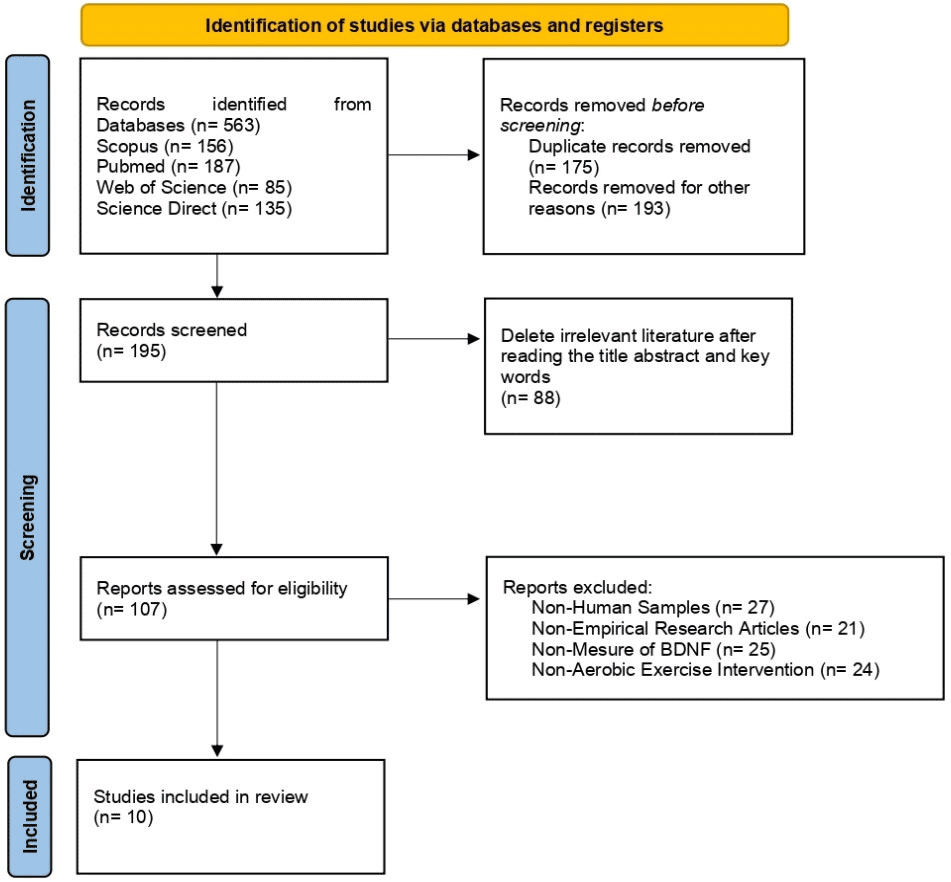
Each publication's complete text, abstract, and title were added to the Mendeley database following review and confirmation. Using Scopus, Science Direct, Pubmed, and Web of Science, 563 publications were found during the initial screening stage. 195 qualified papers were chosen for the second screening stage following the identification of duplicate articles and the reasons behind title irregularities. In the next phase, 107 papers were identified based on the concordance of the reviewed titles, abstracts, and keywords. After reviewing each paper, we decided that the study should be experimental, the parameter should be a BDNF biomarker, the intervention should be aerobic exercise, and the sample should be human. We examined these publications to identify those that satisfied our predefined inclusion criteria. Following a rigorous review and observation process, ten papers that satisfied the inclusion criteria were chosen for analysis. This systematic review was conducted and reported in accordance with the Preferred Reporting Items for Systematic Reviews and Meta-Analyses (PRISMA) guidelines (Figure). This study reviews previous literature that meets bioethical and ethical standards. The studies we analyzed from the literature have undergone an ethical screening process based on the Helsinki Declaration.
RESULTS AND DISCUSSION
Author Design Participants Participants Age Intervention Outcome [22] (Munoz et al., 2024) Randomized controlled trials 62 college students 20 years Exercise Program The nine functional exercises in the single moderate-intensity training session ranged from 70% to 80% intensity and involved moderate cardiovascular demands. The first exercise is an agility ladder exercise in which the participant uses a ladder placed on the ground to do low jumps with his feet while alternating between using his right and left support. The second exercise In the third exercise, athletes combine step-ups and bodyweight squats. It has been demonstrated that aerobic exercise dramatically increases BDNF expression Moving forward between five cones placed on the ground is the agility difficulty in the fourth exercise. The fifth exercise is the The foothold lateral sidestep In the seventh exercise, participants execute leaps and squats. Dumbbell step-ups are a part of the eighth exercise, which The athlete cross-steps and shuffles laterally in the ninth exercise, [23] (Roh et al., 2020) Randomized controlled trials 20 respondents participated in this study 12 years Exercise Program Taekwondo training BDNF levels increased [24] (Jeon & Ha, 2015) Randomized controlled trials 20 junior-high school students 15 years Exercise Program The exercise group engaged For eight weeks, the control group was instructed to maintain their regular sedentary routines, while the exercise group worked The intensity of aerobic activity for the intervention was established by measuring the maximal oxygen uptake (VO2max) of each participant A treadmill was used for the exercise, and the intensity was adjusted between 40% and 60% Following aerobic activity, BDNF expression significantly increased [25] (Jeon & Ha, 2017) Randomized controlled trials 40 male students 15 years Exercise Program For 12 weeks, the training sessions were held four times a week Using the American College Following 12 weeks of aerobic activity, BDNF at rest was significantly higher in the moderate intensity exercise group (p<0.05) and the high intensity exercise group (p<0.01) than it was before the intervention [26] (Hakansson et al., 2017) Randomized controlled trials 19 healthy older adults 65-85 years Exercise Program For thirty-five minutes, BDNF expression significantly increased in the group that engaged in physical exercise [27] (Morais et al., 2018) Randomized controlled trials 22 peserta participants 58 years Exercise Program For two weeks in a row, patients were instructed to walk once The study's findings demonstrated that throughout the chronic post-stroke phase, a single 30-minute session of moderate-intensity aerobic exercise increased [28] (Vedovelli & Giacobbo, 2017) Randomized controlled trials 32 eligible participants ≥75 years Exercise Program 60 minutes of aerobic physical activity per session. Physical activity performed BDNF levels increased [29] (Sugimoto et al., 2025) Randomized controlled trials 14 healthy adults 29 years Exercise Program Electrically stimulated eccentric contractions of antagonist muscles to create a hybrid training system (HTS) that combines voluntary muscle contractions with electrical stimulation of antagonist muscles. Using electrical stimulation, Participants engage in 30 minutes of ergometer training Participants were guided Following exercise, HERG [30] (Silveira Rodrigues et al., 2023) Randomized controlled trials 11 T2DM subjects 63 years Exercise Program These 40-minute workouts took place between 2:00 AM A treadmill was used There was no warm-up before There was a significant increase [31] (Raharjo et al., 2021) Randomized controlled trials A total of 14 obese female adolescents 19-24 years Exercise Program With a 5-minute warm-up (HRmax 50-60%), 30 minutes of continuous activity (HRmax 60-70%), and From 7:00 to 9:00 western indonesian time, physical activity was conducted According to the study's findings, obese women's serum BDNF levels rise after a single morning session of moderate-intensity exercise
is jumping rope.
conventional push-up.
is the sixth exercise.
is comparable to the third.
which uses carioca
5x a week for 16 weeks
significantly after the intervention
in aerobic exercise under supervision for eight weeks.
out three days a week.
in the exercise group.
of VO2R using the ACSM-recommended scale
at University D in Yongin.
of Sports Medicine (ACSM) suggested scale, training intensities were set at 40% VO2R, 55% VO2R, and 70% VO2R for each group. Low-, moderate-, and high-intensity training were all conducted on a treadmill
the physical exercise group engaged in moderately
intense exercise
a week for 30 minutes in the goal training zone (low intensity,
50-63% of maximum heart rate, and moderate intensity, 64-76%
of maximum heart rate)
blood BDNF levels
3 times a week for 3 months
after the intervention
a training technique that combines a traditional bicycle ergometer with HTS (HERG) raises
the training intensity
of a traditional cycling ergometer.
at an intensity suitable for their AT following a 2-minute
warm-up at 30 W.
and observed to maintain their goal heart rate and a cadence
of 60-80 rpm throughout the exercise
and cycle ergometer exercise
both markedly raised BDNF
and lactate levels
and 4:00 PM and were
separated by 72 hours.
for the exercises.
the workouts, and following post-exercise blood collection and cognitive testing, a cool-down consisting of thigh, hip, neck, and back stretching exercises was conducted. The six-minute walk test (6MWT) was used to gauge the AER exercise's intensity.
The 6MWT requires participants to walk for six minutes
in a 30-meter indoor area at their fastest pace (Rikli and Jones 2013). Walking at 90–95% of the 6MWT speed is required of participants
in the AER
in BDNF expression
after physical exercise
a 5-minute cool-down (HRmax 50-60%), the participants engaged in physical exercise for 40 minutes at an intensity of 60-70% of HRmax.
on a Richter Treadmill
(4.0 HP DC). A Polar Heart Rate Monitor (Polar H10 Heart Rate Sensor, Inc., USA) was used to track heart rate during moderate-intensity physical activity. Every participant in the control group stayed sat
and rested until the physical
activity was finished
The purpose of this study was to carry out a systematic review to look into how aerobic exercise affects human BDNF levels. The findings demonstrated that aerobic exercise raises BDNF levels in people. According to past research, aerobic exercise significantly increases BDNF levels [22]. According to the findings of earlier studies, doing aerobic exercise on a treadmill three times a week for eight weeks significantly increases BDNF levels [24]. According to the American College of Sports Medicine's (ACSM) recommended scale, each group's exercise intensity was set at 40%, 55%, and 70% VO2R. On a treadmill, exercises at low, moderate, and high intensities were performed. Exercise significantly raises BDNF levels, according to research [25].
Another study's results indicate that the senior physical activity group engaged in moderate-intensity exercise for 35 minutes significantly raised their BDNF levels following exercise [26]. It was demonstrated that walking for 30 minutes once a week for two weeks in a row between 50 and 63% of maximum heart rate for low intensity and 64 and 76% of maximum heart rate for moderate exercise, which is the goal training zone had a substantial effect on elevated BDNF levels [27]. Another study described using an ergometer for 30 minutes at a level of intensity suitable for their skill level. Participants were guided and observed to maintain their goal heart rate and a cadence of 60-80 rpm throughout the activity. Following the intervention, BDNF levels significantly increased, according to the data [29].
Previous studies' findings demonstrated that aerobic exercise on a treadmill significantly raised BDNF levels as well [30]. According to other studies, physical activity that is performed for 40 minutes at an intensity of 60-70% HRmax, with a 5-minute warm-up (50-60% HRmax), 30 minutes of continuous movement (60-70% HRmax), and a 5-minute cool-down (50-60% HRmax) all significantly raise BDNF levels [31]. Thus, based on the systematic review conducted, it is clear that aerobic exercise increases BDNF levels, an indicator of performance and cognitive function. However, the underlying mechanisms still require in-depth discussion of the physiological and molecular mechanisms. Therefore, in the following discussion, we will attempt to provide a discussion related to this.
Molecular mechanisms of aerobic exercise increase BDNF levels
One non-pharmacological method of enhancing public health is aerobic exercise. Additionally, higher rises after an intense workout, in serum BDNF levels in athletes may suggest that the CNS is still sensitive enough to support neurotrophin synthesis, which is triggered by cytokine production after the contraction of skeletal muscles. 'Exercise' is the aggregate term for the release of a range of myokines, cytokines, and peptides [32].
The human body's skeletal muscles, in particular, physically produce more reactive oxygen species (ROS) during physical activity [33]. Frequent stressors like physical exercise cause oxygen depletion, which makes it difficult for the body to satisfy its rapidly increasing oxygen demands. Among the extremely reactive substances are reactive oxygen species and reactive nitrogen species (RNS) produced by several tissues and organs as a result of this [34]. Other signal transduction pathways will be impacted by ROS. Since it is a physiological response to physical activity, the rise in ROS during exercise has long been discussed and is perfectly normal. ROS is the initial step in the signal transduction mechanism that influences the increase in adenosine monophosphate-activated protein kinase (AMPK) and initiates the production of PGC-1α [35]. In muscle cells, adenosine monophosphate-activated protein kinase (AMPK) has a unique role in binding PGC-1α. Remarkably, PGC-1α regulates mitochondrial biogenesis and also has an impact on mitophagy and mitochondrial dynamics [36].
Prior studies have demonstrated that physical activity increases PGC-1α expression (Ayubi et al., 2025). There are various ways that this interaction can take place. To boost AMPK's kinase activity, PGC-1α can first directly bind and activate it [38]. Second, PGC-1α triggers the expression of target genes for AMPK signaling that are involved in the oxidation of fatty acids [38]. It is well known that Sirtuin 1 (SIRT1) deacetylates a number of transcription factors and significant proteins that activate AMPK [39]. The response to elevated PGC-1α expression is influenced by this activated SIRT1 [38]. PGC-1α, expressed in skeletal muscles, is crucial for maintaining metabolic function because it promotes glucose homeostasis, oxidative capacity, mitochondrial biogenesis, insulin sensitivity, suppresses muscles atrophy, and reduces systemic inflammation [40].
PGC-1α controls the skeletal muscle's expression of fibronectin type III domain-containing protein 5 (FNDC5) [41], which is released into the bloodstream after being broken down into irisin [42]. PGC-1 alpha may be a major molecular initiator of BDNF responses in enriched environments and during physical activity [43], was identified as a byproduct of muscular contraction and exercise [44]. An attempt was made to explain the health benefits of physical activity on metabolic status in terms of browning (i.e., conversion) of white adipose tissue (WAT) and its resistance to diet-induced obesity by identifying irisin as a hormonal factor or myokine (a polypeptide of 112 amino acids) that is cleaved under the transcriptional control of PGC1-α from the fibronectin type III transmembrane precursor domain-containing 5 (FNDC5) [45], in reaction to physical activity. Exercise-induced irisin secretion may be influenced by elevated FNDC5 [45].
According to research, irisin, a myokine generated during exercise, can indirectly modify BDNF levels via improving metabolic processes that impact the general effectiveness and function of the central nervous system [46]. In people with risk factors like metabolic syndrome, these interactions establish irisin as a myokine that promotes mental wellness, brain plasticity, and metabolic health [47]. It is also important to note that irisin is one of the few stimuli that is known to cause neurogenesis in this environment [48], it also reduces synapse loss and neuronal damage [49]. Indeed, research conducted both in vitro and in vivo has demonstrated that irisin promotes brain progenitor cell development and upregulates the expression of neurotrophic factors like BDNF [50]. In this instance, irisin-induced elevated BDNF signaling encourages synaptic plasticity, dendritic spine development, and, eventually, enhances cognitive function [51]. A crucial neurotrophic factor involved in neurogenesis, synaptogenesis, differentiation, neuroplasticity, neurotransmission, and neuronal survival, irisin is an upstream modulator of brain-derived neurotrophic factor (BDNF) [9]. It is believed that irisin increases BDNF expression, which mediates exercise-induced neuroprotection [52]. So it is known that irisin secretion after exercise has an impact on increasing BDNF levels which will have an impact on improving cognitive function [52].
Strenght and Limitations
This systematic review has the advantage of focusing only on randomized controlled trials, the most reliable form of scientific evidence, and eliminating the potential for ambiguous causal relationships. Furthermore, the collected samples focused on humans, provided consistent data, and were not mixed with samples from other categories, including animal samples.
One limitation we identified was the lack of information on how exercise, particularly aerobic activity, can increase BDNF levels. Therefore, this study is considered significant for increasing our understanding of how aerobic exercise affects BDNF levels and improves cognitive function. The general population, especially older adults, may benefit from aerobic exercise that prevent cognitive decline. However, this may be related to its effective duration and intensity, which remain unclear. Therefore, further experimental studies are needed to determine the optimal timing and intensity for increasing BDNF levels in humans.
CONCLUSION
1. Brain-Derived Neurotrophic Factor levels, a biomarker and indicator of cognitive function, have been shown to increase in response to aerobic exercise.
2. Therefore, aerobic exercise is an excellent non-pharmacological treatment for slowing age-related cognitive decline, especially in older adults.
3. It can also be applied therapeutically to mitigate additional negative effects associated with aging.
Contributors:
Priambodo A. – data curation, visualization, writing – review & editing;
Ayubi N. – conceptualization, writing – original draft;
Wibawa J.C. – conceptualization, writing – original draft;
Kurnaz M. – methodology, formal analysis.
Acknowledgement
This research is not currently receiving funding from any source. We would like to thank the authors who contributed to this work.
Funding. This research received no external funding.
Conflict of interests. The authors declare no conflict of interest.
REFERENCES
1. Sexton C, Solis M, Aharon-Peretz J, Alexopoulos P, Apostolova LG, Bayen E, et al. Alzheimer's disease research progress in the Mediterranean region: The alzheimer's association international conference satellite symposium. Alzheimers Dement. 2022 Oct;18(10):1957-68. doi: https://doi.org/10.1002/alz.12588
2. 2024 Alzheimer's disease facts and figures. Alzheimers Dement. 2024 May;20(5):3708-821. doi: https://doi.org/10.1002/alz.13809
3. Serrano-Pozo A, Das S, Hyman BT. APOE and Alzheimer's disease: advances in genetics, pathophysiology, and therapeutic approaches. Lancet Neurol. 2021 Jan;20(1):68-80. doi: https://doi.org/10.1016/S1474-4422(20)30412-9
4. Alzheimer's Association 2025 Alzheimer's disease facts and figures. Alzheimers Dement. 2025;21(4):e70235. doi: https://doi.org/10.1002/alz.70235
5. GBD 2021 Diseases and injuries collaborators. Global incidence, prevalence, years lived with disability (YLDs), disability-adjusted life-years (DALYs), and healthy life expectancy (HALE) for 371 diseases and injuries in 204 countries and territories and 811 subnational locations, 1990-2021: a systematic analysis for the Global Burden of Disease Study 2021. Lancet. 2024 May 18;403(10440):2133-61. doi: https://doi.org/10.1016/S0140-6736(24)00757-8
6. GBD 2021 Demographics Collaborators. Global age-sex-specific mortality, life expectancy, and population estimates in 204 countries and territories and 811 subnational locations, 1950-2021, and the impact of the COVID-19 pandemic: a comprehensive demographic analysis for the Global Burden of Disease Study 2021. Lancet. 2024 May 18;403(10440):1989-2056. doi: https://doi.org/10.1016/S0140-6736(24)00476-8
7. Szarowicz CA, Steece-Collier K, Caulfield ME. New frontiers in neurodegeneration and regeneration associated with Brain-Derived neurotrophic factor and the rs6265 single nucleotide polymorphism. Int J Mol Sci. 2022 Jul 20;23(14):8011. doi: https://doi.org/10.3390/ijms23148011
8. Surget A, Belzung C. Adult hippocampal neurogenesis shapes adaptation and improves stress response : a mechanistic and integrative perspective. Mol Psychiatry. 2022 Jan;27(1):403-21. doi: https://doi.org/10.1038/s41380-021-01136-8
9. Colucci-D'Amato L, Speranza L, Volpicelli F. Neurotrophic factor bdnf, physiological functions and therapeutic potential in depression, neurodegeneration and brain cancer. Int J Mol Sci. 2020 Oct 21;21(20):7777. doi: https://doi.org/10.3390/ijms21207777
10. Shen R, Ardianto C, Celia C, Sidharta VM, Sasmita PK, Satriotomo I, et al. Brain-derived neurotrophic factor interplay with oxidative stress : neuropathology approach in potential biomarker of Alzheimer ’ s disease. Dement Neuropsychol. 2023 Dec 4;17:e20230012. doi: https://doi.org/10.1590/1980-5764-DN-2023-0012
11. Ali NH, Al-Kuraishy HM, Al-Gareeb AI, Alnaaim SA, Saad HM, Batiha GE. The molecular pathway of p75 Neurotrophin receptor (p75NTR) in Parkinson’s disease: The way of new inroads. Mol Neurobiol. 2024 May;61(5):2469-80. doi: https://doi.org/10.1007/s12035-023-03727-8
12. Azman KF, Zakaria R. Recent advances on the role of Brain-Derived neurotrophic factor (BDNF) in neurodegenerative diseases. Int J Mol Sci. 2022 Jun 19;23(12):6827. doi: https://doi.org/10.3390/ijms23126827
13. Murawska-Ciałowicz E, Wiatr M, Ciałowicz M, Gomes de Assis G, Borowicz W, Rocha-Rodrigues S, et al. Bdnf impact on biological markers of depression – role of physical exercise and training. Int J Environ Res Public Health. 2021 Jul 15;18(14):7553. doi: https://doi.org/10.3390/ijerph18147553
14. Diniz DM, Franze S, and Homberg JR. Crossing the Blood-Brain-Barrier: a bifunctional liposome for BDNF gene delivery – a pilot study. BioRxiv. 2020. doi: https://doi.org/10.1101/2020.06.25.171264.
15. Dou SH, Cui Y, Huang SM, Zhang B. The role of Brain-Derived neurotrophic factor signaling in central nervous system disease pathogenesis. Front Hum Neurosci. 2022 Jun 24;16:924155. doi: https://doi.org/10.3389/fnhum.2022.924155
16. Li Y, Chen J, Yu H, Ye J, Wang C, Kong L. Serum brain-derived neurotrophic factor as diagnosis clue for Alzheimer’s disease: A cross-sectional observational study in the elderly. Front. Psychiatry, Front Psychiatry. 2023 Mar 16;14:1127658. doi: https://doi.org/10.3389/fpsyt.2023.1127658
17. Hu J, Huang B, Chen K. The impact of physical exercise on neuroinflammation mechanism in Alzheimer’s disease. Front Aging Neurosci. 2024 Aug 21;16:1444716. doi: https://doi.org/10.3389/fnagi.2024.1444716
18. Maeneja R, Silva CR, Ferreira IS, Abreu AM. Aerobic physical exercise versus dual-task cognitive walking in cognitive rehabilitation of people with stroke: a randomized clinical trial. Front Psychol. 2023 Oct 13;14:1258262. doi: https://doi.org/10.3389/fpsyg.2023.1258262
19. Serra L, Petrosini L, Mandolesi L, Bonarota S, Balsamo F, Bozzali M, et al. Walking, running, swimming: an analysis of the effects of land and water aerobic exercises on cognitive functions and neural substrates. Int J Environ Res Public Health. 2022 Dec 6;19(23):16310. doi: https://doi.org/10.3390/ijerph192316310
20. Huang B, Chen K, Li Y. Aerobic exercise, an effective prevention and treatment for mild cognitive impairment. Front Aging Neurosci. 2023 Aug 8;15:1194559. doi: https://doi.org/10.3389/fnagi.2023.1194559
21. Choi JW, Jo SW, Kim DE, Paik IY, Balakrishnan R. Aerobic exercise attenuates LPS-induced cognitive dysfunction by reducing oxidative stress, glial activation, and neuroinflammation. Redox Biol. 2024 May;71:103101. doi: https://doi.org/10.1016/j.redox.2024.103101
22. Muñoz Ospina B, Cadavid-Ruiz N. The effect of aerobic exercise on serum brain-derived neurotrophic factor (BDNF) and executive function in college students. Ment Health Phys Act. 2024;26:100578. doi: https://doi.org/10.1016/j.mhpa.2024.100578
23. Roh HT, Cho SY, So WY. Effects of regular taekwondo intervention on oxidative stress biomarkers and myokines in overweight and obese adolescents. Int J Environ Res Public Health. 2020 Apr 6;17(7):2505. doi: https://doi.org/10.3390/ijerph17072505
24. Jeon YK, Ha CH. Expression of brain-derived neurotrophic factor, IGF-1 and cortisol elicited by regular aerobic exercise in adolescents. J Phys Ther Sci. 2015 Mar;27(3):737-41. doi: https://doi.org/10.1589/jpts.27.737
25. Jeon YK, Ha CH. The effect of exercise intensity on brain derived neurotrophic factor and memory in adolescents. Environ Health Prev Med. 2017 Apr 4;22(1):27. doi: https://doi.org/10.1186/s12199-017-0643-6
26. Håkansson K, Ledreux A, Daffner K, Terjestam Y, Bergman P, Carlsson R, et al. BDNF responses in healthy older persons to 35 minutes of physical exercise, cognitive training, and mindfulness: associations with working memory function. J Alzheimers Dis. 2017;55(2):645-57. doi: https://doi.org/10.3233/JAD-160593
27. Morais VAC, Tourino MFDS, Almeida ACS, Albuquerque TBD, Linhares RC, Christo PP, et al. A single session of moderate intensity walking increases brain-derived neurotrophic factor (BDNF) in the chronic post-stroke patients. Top Stroke Rehabil. 2018 Jan;25(1):1-5. doi: https://doi.org/10.1080/10749357.2017.1373500
28. Vedovelli K, Giacobbo BL, Corrêa MS, Wieck A, Argimon IIL, Bromberg E. Multimodal physical activity increases brain-derived neurotrophic factor levels and improves cognition in institutionalized older women. Geroscience. 2017 Aug;39(4):407-17. doi: https://doi.org/10.1007/s11357-017-9987-5
29. Sugimoto T, Hashida R, Iwanaga S, Baba E, Omoto M, Nakano D, et al. Increase in Brain-Derived neurotrophic factor after cycling exercise resisting electrically stimulated antagonist muscle contractions in overweight japanese people: a randomized, controlled, single-blind, crossover trial. Cureus. 2025 Mar 17;17(3):e80694. doi: https://doi.org/10.7759/cureus.80694
30. Silveira-Rodrigues JG, Campos BT, de Lima AT, Ogando PHM, Gomes CB, et al. Acute bouts of aerobic and resistance exercise similarly alter inhibitory control and response time while inversely modifying plasma BDNF concentrations in middle-aged and older adults with type 2 diabetes. Exp Brain Res. 2023 Apr;241(4):1173-83. doi: https://doi.org/10.1007/s00221-023-06588-8
31. Raharjo S, Harisman ASM, Andiana O, Pamungkas YP. Brain-derived neurotrophic factor in blood increases transiently after single sessions of moderate intensity exercise in obese females. J Sport J Penelit Pembelajaran. 2021;7(3):333-46. doi: https://doi.org/10.29407/js_unpgri.v7i3.16372
32. Zare N, Bishop DJ, Levinger I, Febbraio MA, Broatch JR. Exercise intensity matters : A review on evaluating the effects of aerobic exercise intensity on muscle-derived neuroprotective myokines. Alzheimers Dement (NY). 2025 Feb 19;11(1):e70056. doi: https://doi.org/10.1002/trc2.70056
33. Wang F, Wang X, Liu Y, Zhang Z. Effects of exercise-induced ROS on the pathophysiological functions of skeletal muscle. Oxid Med Cell Longev. 2021;2021:3846122. doi: https://doi.org/10.1155/2021/3846122
34. Powers SK, Deminice R, Ozdemir M, Yoshihara T, Bomkamp MP, Hyatt H. Exercise-induced oxidative stress: Friend or foe? J Sport Health Sci. 2020;9(5):415-25. doi: https://doi.org/10.1016/j.jshs.2020.04.001
35. Agostini F, Bisaglia M, Plotegher N. Linking ROS levels to autophagy: the key role of AMPK. Antioxidants (Basel). 2023 Jul 10;12(7):1406. doi: https://doi.org/10.3390/antiox12071406
36. Abu Shelbayeh O, Arroum T, Morris S, Busch KB. PGC-1 α Is a master regulator of mitochondrial lifecycle and ROS stress response. Antioxidants (Basel). 2023;12(5):1075. doi: https://doi.org/10.3390/antiox12051075
37. Ayubi CCN, Wibawa JC, Rizki AZ, Afand A. Physiological regulation of peroxisome proliferator-activated receptor-gamma coactivator 1 alpha in mitochondrial metabolism during physical exercises: a systematic review. Medicni Perspektivi. 2025;8(1):27-37. doi: https://doi.org/10.26641/2307-0404.2025.2.333361
38. Mozaffaritabar S, Koltai E, Zhou L, Bori Z, Kolonics A, Kujach S, et al. PGC – 1α activation boosts exercise – dependent cellular response in the skeletal muscle. J Physiol Biochem. 2024 May;80(2):329-35. doi: https://doi.org/10.1007/s13105-024-01006-1
39. Radak Z, Suzuki K, Posa A, Petrovszky Z, Koltai E, Boldogh I. The systemic role of SIRT1 in exercise mediated adaptation. Redox Biol. 2020 Aug;35:101467. doi: https://doi.org/10.1016/j.redox.2020.101467
40. Mthembu SXH, Mazibuko-Mbeje SE, Ziqubu K, Muvhulawa N, Marcheggiani F, Cirilli I. Potential regulatory role of PGC – 1α within the skeletal muscle during metabolic adaptations in response to high – fat diet feeding in animal models. Pflugers Arch. 2024 Mar;476(3):283-93. doi: https://doi.org/10.1007/s00424-023-02890-0
41. Cho C, Ji M, Cho E, Yi S, Kim JG, Lee S. Chronic voluntary wheel running exercise ameliorates metabolic dysfunction via PGC – 1α expression independently of FNDC5 / irisin pathway in high fat diet – induced obese mice. J Physiol Sci. 2023 Apr 11;73(1):6. doi: https://doi.org/10.1186/s12576-023-00864-6
42. Negroiu CE, Tudoraşcu RI, Dănoiu S, Pădureanu V, Godeanu S, Dănoiu R, et al. Physical exercise and irisin: managing obesity and related comorbidities. Rom J Morphol Embryol. 2025 Apr-Jun;66(2):323-33. doi: https://doi.org/10.47162/RJME.66.2.05
43. Bi X, Fang J, Jin X, Thirupathi A. The interplay between BDNF and PGC-1 alpha in maintaining brain health: role of exercise. Front Endocrinol (Lausanne). 2024 Aug 22;15:1433750. doi: https://doi.org/10.3389/fendo.2024.1433750
44. Motter A. Muscle Biochemistry: The Molecular Basis of Muscle Contraction and Energy Production. Clin Med Biochem. 2023;9(1000162):1-2. doi: https://doi.org/10.35841/2471-2663.23.9.162
45. Paoletti I, Coccurello R. Irisin: A multifaceted hormone bridging exercise and disease pathophysiology. Int J Mol Sci. 2024;25(24):1-27. doi: https://doi.org/10.3390/ijms252413480
46. Leger C, Quirié A, Méloux A, Fontanier E, Chaney R, Basset C, et al. “Impact of exercise intensity on cerebral BDNF levels: role of FNDC5/Irisin. Int J Mol Sci. 2024 Jan 19;25(2):1213. doi: https://doi.org/10.3390/ijms25021213
47. Villamil-Parra W, Moscoso-Loaiza L. Effects of physical exercise on Irisin and BDNF concentrations, and their relationship with cardiometabolic and mental health of individuals with metabolic syndrome: a systematic review. Exp Gerontol. 2024 Dec;198:112640. doi: https://doi.org/10.1016/j.exger.2024.112640
48. Wang Y, Tian M, Tan J, Pei X, Lu C, Xin Y, et al. Irisin ameliorates neuroinflammation and neuronal apoptosis through integrin αVβ5/AMPK signaling pathway after intracerebral hemorrhage in mice. J Neuroinflammation. 2022 Apr 7;19(1):82. doi: https://doi.org/10.1186/s12974-022-02438-6
49. Colom-Cadena M, Spires-Jones T, Zetterberg H, Blennow K, Caggiano A, et al. The clinical promise of biomarkers of synapse damage or loss in Alzheimer’s disease. Alzheimers Res Ther. 2020 Mar 2;12(1):21. doi: https://doi.org/10.1186/s13195-020-00588-4
50. Lourenco MV, de Freitas GB, Raony Í, Ferreira ST, De Felice FG. Irisin stimulates protective signaling pathways in rat hippocampal neurons. Front Cell Neurosci. 2022 Sep 9;16:953991. doi: https://doi.org/10.3389/fncel.2022.953991
51. Minuti A, Raffaele I, Scuruchi M, Lui M, Muscarà C, Calabrò M. Role and functions of Irisin: a perspective on recent developments and neurodegenerative diseases. Antioxidants (Basel). 2025 May 7;14(5):554. doi: https://doi.org/10.3390/antiox14050554
52. Bayfield J, Elford HR, Christie BR. Examining a role for irisin in treating cerebral ischemia. J Neurophysiol. 2025 Apr 1;133(4):1320-8. doi: https://doi.org/10.1152/jn.00027.2025