

 UK
UK  EN
EN 


V.V. Ogorenko
 V.O. Kokashynskyi *
A.V. Shornikov
O.A. Makoviichuk
B.I. Bakhtin
V.O. Kokashynskyi *
A.V. Shornikov
O.A. Makoviichuk
B.I. Bakhtin
Key words: posttraumatic stress disorder, depression, anxiety, war, mental health, medical students
Ключові слова: посттравматичний стресовий розлад, депресія, тривога, війна, психічне здоров’я, студенти-медики
Abstract
The study aimed to assess the prevalence and comorbidity of posttraumatic stress disorder, depressive and anxiety symptoms among medical students in the context of prolonged war-related stress. The aim of the study was to assess the prevalence and comorbidity of symptoms of post-traumatic stress disorder, depression, and anxiety among medical students in the context of a prolonged armed conflict. A cross-sectional observational study was conducted involving 85 medical students. Traumatic experience was assessed using the Life Events Checklist for DSM-5, posttraumatic stress symptoms were evaluated with the PTSD Checklist for DSM-5, depressive symptoms were measured using the Patient Health Questionnaire-9, and anxiety symptoms were assessed with the Generalized Anxiety Disorder-7 scale. In addition, cumulative trauma load and help-seeking behavior for psychiatric care were analyzed. Probable posttraumatic stress disorder was identified in 38.8% of students, clinically significant depressive symptoms in 50.6%, and anxiety symptoms in 36.5%. Strong positive correlations were identified between posttraumatic stress disorder, depressive, and anxiety symptoms (ρ=0.628-0.739; p<0.001). Cumulative traumatic exposure showed moderate correlations with the severity of posttraumatic stress disorder, depressive, and anxiety symptoms (ρ=0.381-0.472; p<0.001). After controlling for affective symptomatology, the association between PTSD symptoms and the personal trauma index remained statistically significant (ρ=0.489; p<0.001). Despite the high prevalence of mental health disturbances, only one fifth of respondents sought professional help. The findings indicate a substantial psychoemotional burden among medical students in wartime conditions and substantiate the need for systematic screening, early identification, and the implementation of psychosocial support programs within higher medical education institutions.
Реферат
Поширеність та коморбідність симптомів ПТСР, депресії та тривоги серед студентів-медиків. Огоренко В.В., Кокашинський В.О., Шорніков А.В., Маковійчук О.А., Бахтін Б.І. Дослідження присвячене оцінці поширеності та коморбідності симптомів посттравматичного стресового розладу, депресії та тривоги серед студентів-медиків в умовах тривалого воєнного конфлікту. Метою дослідження було оцінити поширеність та коморбідність симптомів посттравматичного стресового розладу, депресії та тривоги серед студентів-медиків в умовах тривалого воєнного конфлікту. Проведено одномоментне поперечне обсерваційне дослідження за участю 85 здобувачів вищої медичної освіти. Оцінювання травматичного досвіду здійснювали за Life Events Checklist for DSM-5, симптоми посттравматичного стресового розладу оцінювали за допомогою PTSD Checklist for DSM-5, депресивні симптоми оцінювали за шкалою Patient Health Questionnaire-9, а тривожні симптоми оцінювали за допомогою Generalized Anxiety Disorder-7. Додатково аналізували кумулятивний показник травматизації та факт звернення по психіатричну допомогу. Встановлено, що ймовірний посттравматичний стресовий розлад виявився в 38,8% студентів, клінічно значущі депресивні симптоми – у 50,6%, тривожні – у 36,5%. Між симптомами посттравматичного стресового розладу, депресії та тривоги виявлено сильні позитивні кореляції (ρ=0,628-0,739; p<0,001). Кумулятивна травматична експозиція помірно корелювала з вираженістю симптомів посттравматичного стресового розладу, депресії та тривоги (ρ=0,381-0,472; p<0,001). Після контролю афективної симптоматики зв’язок між симптомами посттравматичного стресового розладу та індексом особистої травматизації залишався статистично значущим (ρ=0,489; p<0,001). Незважаючи на високу поширеність психічних порушень, лише п’ята частина респондентів зверталася по професійну допомогу. Отримані результати свідчать про значний психоемоційний тягар у студентів-медиків в умовах війни та обґрунтовують необхідність упровадження системного скринінгу, раннього виявлення і програм психосоціальної підтримки в закладах вищої медичної освіти.
The process of adaptation during the first years of higher education represents one of the most pressing challenges of modern society, as this period is characterized by the intensive formation of professional identity, value orientations, and career-related attitudes of future specialists. The first years of study are accompanied by a change in social status, increased responsibility, the necessity to master substantial volumes of information and integration into a new academic environment, which requires significant mobilization of internal psychological resources.
According to the recommendations of the World Health Organization, the preservation and promotion of youth health is defined as one of the priority areas for the development of healthcare systems in the twenty-first century. In this context, particular attention should be given to students of medical higher education institutions, whose professional training is associated with considerable psychoemotional and physical demands. Medical students constitute a high-risk group for the development of emotional exhaustion, anxiety and depressive conditions due to excessive academic workload, competitive educational environments, the combination of study with clinical employment, chronic sleep deprivation, and insufficient rest. Prolonged exposure to these factors may lead to reduced adaptive capacity, disruption of psychosomatic balance and the early development of professional burnout during the educational stage [1, 2].
Traumatic stress represents a distinct and growing concern. Among medical students, symptoms of posttraumatic stress disorder (PTSD) may develop both in response to acute traumatic events and as a consequence of prolonged cumulative stress exposure [3]. Systematic reviews indicate that PTSD symptoms in medical students frequently co-occur with anxiety and depressive symptoms, suggesting a high level of psychiatric comorbidity within this population [4].
In countries affected by armed conflict, the mental health of university students is exposed to multidimensional adverse influences that extend far beyond routine academic stress. Medical students represent a particularly vulnerable subgroup. Direct threats to life, personal losses, forced displacement, disruption of social networks, and instability of the educational process create a persistent background of psychological traumatization. Empirical studies conducted among medical students in regions experiencing active hostilities report high prevalence rates of depressive symptoms, anxiety disorders, and PTSD [5, 6]. At the same time these conditions often present in a latent or subclinical form, complicating timely detection and intervention.
In this regard, the implementation of comprehensive psychosocial support programs, early mental health screening systems, and resilience-building strategies becomes critically important as components of ensuring the sustainability of medical education under wartime conditions. For Ukraine, this issue is particularly relevant in the context of prolonged war and chronic stress exposure. Recent studies demonstrate a high prevalence of depressive and anxiety symptoms among medical students and a substantial proportion of individuals with pronounced posttraumatic manifestations, even in relatively rear regions of the country, thereby significantly increasing the overall psychological burden [7, 8]. However, data on the comorbidity of PTSD, depressive and anxiety symptoms based on standardized assessment instruments remain limited.
Therefore, it is important to conduct research among medical students aimed at the simultaneous assessment of PTSD, depressive and anxiety symptoms, as well as the analysis of their comorbidity. Such studies are necessary for the development of targeted mental health support programs within medical higher education institutions. They also contribute to the optimization of screening procedures and the planning of early preventive and corrective interventions. These measures are aimed at preserving mental health, enhancing stress resilience, and fostering self-regulation skills, which are integral components of future physicians’ professional competence.
Aim of the study: to assess the prevalence and comorbidity of PTSD, depressive and anxiety symptoms among medical students in the context of prolonged armed conflict.
MATERIALS AND METHODS OF RESEARCH
A cross-sectional observational study was conducted to assess the associations between traumatic exposure, psychopathological symptoms, and help-seeking behavioral patterns. A total of 85 medical students from Dnipro State Medical University were included in the study.
Participants were recruited on a voluntary basis through anonymous survey distribution using a snowball sampling method.
The distribution of participants by gender and year of study is presented in Table 1.
The study was conducted in accordance with the principles of the Declaration of Helsinki. The study design was approved by the Ethics Committee of Dnipro State Medical University (Protocol No. 35, dated February 18, 2026) [9, 10]. Informed voluntary consent was obtained from all participants. Data were collected anonymously and processed in a de-identified form.
Traumatic exposure was assessed using the Life Events Checklist for DSM-5 (LEC-5), a standardized instrument designed to screen for lifetime exposure to potentially traumatic events. The analysis was conducted at the level of individual events, clinically meaningful domains (D1-D6) and using a cumulative trauma index (sum of traumatic exposure factors) [11, 12]. PTSD symptoms were measured using the PTSD Checklist for DSM-5 (PCL-5), a cutoff score of ≥33 was applied to identify probable PTSD [13, 14]. Depressive symptoms were assessed with the Patient Health Questionnaire-9 (PHQ-9) [14, 15]. Total score of ≥10 interpreted as indicative of probable clinically significant depression. Anxiety symptoms were evaluated using the Generalized Anxiety Disorder-7 (GAD-7), and scores ≥10 were used to define probable clinically significant anxiety [14, 16]. Cronbach’s α values was 0.95 for the PCL-5, 0.88 for the PHQ-9 and 0.89 for the GAD-7.
Additionally, seeking psychiatric care and the use of psychological self-help tools were analyzed.
Gender Year of study Total 1 2 3 Female 28 21 13 62 (72.9%) Male 10 8 5 23 (27.1%) Total 38 (44.7%) 29 (34.1%) 18 (21.2%) 85
Data processing was performed using licensed software STATISTICA 6.1 (StatSoft Inc., serial number AGAR909E415822FA) and MedCalc® Statistical Software version 20.104 (MedCalc Software Ltd, Ostend, Belgium; https://www.medcalc.org; 2022). Quantitative variables were assessed for normality using the Shapiro-Wilk test. Given the non-normal distribution, data are presented as median (Me) and interquartile range (Q1-Q3). Correlation analysis was conducted using Spearman's nonparametric correlation coefficient. For comparisons across three groups, the nonparametric Kruskal-Wallis analysis of variance was applied. Associations between categorical variables were evaluated using Fisher's exact test; relative risk (RR) and odds ratio (OR) with 95% confidence intervals (CI) were calculated; for small cell sizes, the Haldane-Anscombe correction was applied. Univariate analyses with multiple comparisons were adjusted using the Benjamini-Hochberg method (FDR). Multivariate analysis utilized logistic regression with adjusted odds ratios (aOR). The statistical significance level was set at p<0.05 [17,18].
RESULTS AND DISCUSSION
Descriptive statistics indicated a moderate median severity of PTSD and depressive symptoms, lower median anxiety scores, and a wide range of cumulative traumatic exposure, reflecting substantial heterogeneity in both clinical manifestations and trauma history among participants (Table 2).
Indicator Ме (Q1-Q3) Min-Max PCL-5 (PTSD), score 26 (13-41) 0-78 PHQ-9 (depression), score 10 (5-15) 0-25 GAD-7 (anxiety), score 6 (3-11) 0-21 All traumatization factors 6 (3-11) 0-32
To assess the cumulative impact of traumatic experiences, all traumatization factors (per LEC-5) were summed, calculated as the total of endorsed events, excluding responses of "not applicable" or "not witnessed."
Comparative analysis by gender revealed no statistically significant differences in PCL-5, GAD-7, or cumulative trauma exposure scores. Although PHQ-9 scores tended to be higher among female participants, this difference did not remain statistically significant after correction for multiple comparisons using the false discovery rate (FDR) procedure. Analysis across years of study demonstrated no significant differences in any of the examined variables.
Among the 85 respondents, probable PTSD (PCL-5 ≥33) was found in 38.8% of cases. Clinically significant depressive symptoms (PHQ-9 ≥10) were present in 50.6% of participants, while clinically significant anxiety (GAD-7 ≥10) was observed in 36.5%. Severe depressive symptoms (PHQ-9 ≥15) were detected in 27.1% of participants, and severe anxiety (GAD-7 ≥15) was identified in 9.4% (Table 3).
Indicator Category n (%) Probable PTSD PCL-5 ≥33 33 (38.8) Clinically significant depression PHQ-9 ≥10 43 (50.6) Clinically significant anxiety GAD-7 ≥10 31 (36.5) Severe depression PHQ-9 ≥15 23 (27.1) Severe anxiety GAD-7 ≥15 8 (9.4)
Despite the high prevalence of clinically significant psychopathological symptoms, only 20% of respondents reported seeking professional psychiatric care, while 22.4% indicated the use of psychological self-help strategies.
Psychiatric help-seeking was significantly more frequent among individuals with probable PTSD (PCL-5 ≥33) compared to participants without PTSD (39.4% vs. 7.7%; RR=5.12; OR≈7.10; p<0.001). Participants who sought professional help were characterized by more severity of PTSD and depressive symptoms.
In contrast, the use of psychological self-help strategies was not associated with the presence of PTSD or with the severity of PTSD, depressive, or anxiety symptoms (all p>0.05).
Correlation analysis revealed strong positive associations between PTSD symptoms and affective disorders: between PCL-5 and PHQ-9 (ρ=0.628; p<0.001) and between PCL-5 and GAD-7 (ρ=0.685; p<0.001). Very strong correlation was found between depressive and anxiety symptoms (ρ=0.739; p<0.001). The sum of traumatization factors moderately correlated with PCL-5 (ρ=0.472; p<0.001), PHQ-9 (ρ=0.381; p<0.001), and GAD-7 (ρ=0.404; p<0.001) (Table 4).
Variables PCL-5 PHQ-9 GAD-7 Sum of traumatization factors PCL-5 (ПТСР) 1.000 0.628 0.685 0.472 PHQ-9 0.628 1.000 0.739 0.381 GAD-7 0.685 0.739 1.000 0.404 Sum of traumatization factors 0.472 0.381 0.404 1.000
Partial gender-controlled correlation analysis and year of study showed that PTSD (PCL-5) levels were significantly correlated with depressive (PHQ-9; ρ=0.584; p<0.001) and anxiety symptoms (GAD-7; ρ=0.642; p<0.001), as well as with the total trauma rate (ρ=0.421; p<0.001). The association between depression and anxiety remained strong (ρ=0.703; p<0.001). Cumulative traumatization was moderately associated with depression and anxiety even after accounting for demographic factors. Additional control for PHQ-9 or GAD-7 showed that the association between total traumatization and PCL-5 persisted regardless of the level of depression or anxiety, while the association between PTSD and depressive symptoms was attenuated after accounting for anxiety.
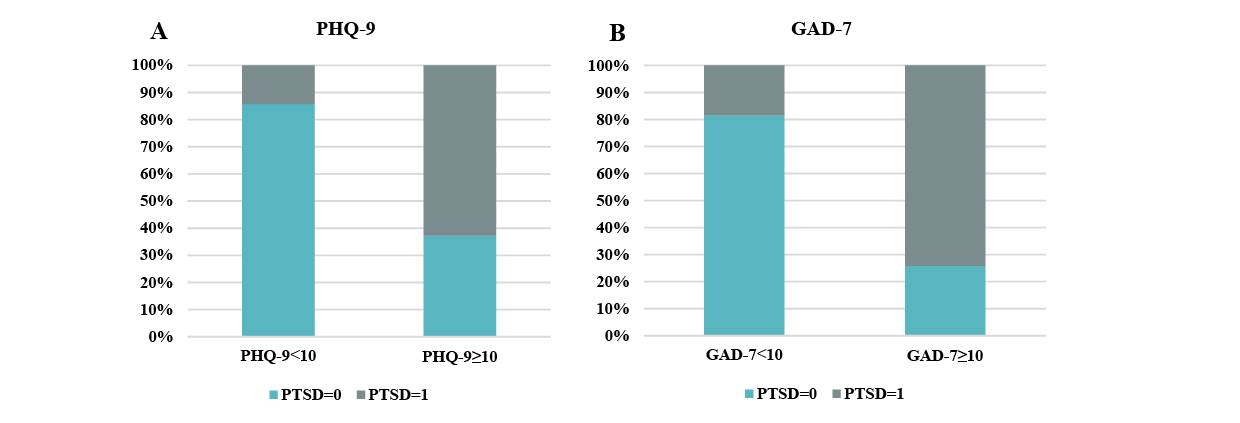
Analysis of associations between categorical variables demonstrated a strong association between probable PTSD (PCL-5 ≥33) and clinically relevant levels of depression (PHQ-9 ≥10; χ²=21.05; p<0.001; Cramér's V=0.498) and anxiety (GAD-7≥10; χ²=25.70; p<0.001; Cramér’s V=0,550). Individuals with clinically significant depression (PHQ≥10) were ten times more likely to have PTSD (OR=10.13; 95% CI 3.50-29.30). Individuals with clinically significant anxiety (GAD≥10) were more than 12 times more likely to belong to the group of probable PTSD compared to respondents without severe anxiety (OR=12.65; 95% CI 4.39-36.43) (Fig. 1).
To verify whether PTSD reflects a specific phenomenon and not just general affective distress, an integral affective factor (z(PHQ-9)+z(GAD-7)) was formed. In the linear model, PCL-5 remained independently associated with the personal trauma index after controlling for affective factor, gender, and course (β=2.10 per +1 personal event; p=0.001). The partial correlation between PCL-5 and the personal trauma index with control for affective factor, gender, and course also remained significant (ρ=0.489; p<0.001), suggesting that PTSD is not reduced to general affective distress.
Sensitivity analysis using alternative clinical thresholds of depressive (PHQ-9 ≥5, ≥10, ≥15) and anxiety symptoms (GAD-7 ≥5, ≥10, ≥15) showed the stability of the results obtained (Table 5). For all thresholds, the same direction of associations with probable PTSD was maintained, with higher resistance points corresponding to a larger effect size. None of the alternative thresholds led to a change in the main findings of the study.
In a multivariate logistic regression model, where the dependent variable was the presence of probable PTSD, and the predictors were scores for PHQ-9 and GAD-7, both anxiety (GAD-7; OR=1.27; 95% CI 1.09-1.50; p=0.003) and depression (PHQ-9; OR=1.15; 95% CI 1.02-1.31; p=0.03) remained the independent predictor. The model was characterized by a high discriminatory ability (ROC-AUC=0.89; 95% CI 0.80-0.95). After including gender, year of study, and total trauma scores into the model, it lost statistical significance, indicating the indirect role of demographic factors in the formation of PTSD.
Factor RR (95% CI) OR (95% CI) PHQ-9 ≥5 20.0 (1.28-312.05)* 39.0 (2.26-672.69)** GAD-7 ≥5 4.83 (1.87-12.51)* 9.88 (3.03-32.22)** PHQ-9 ≥10 4.40 (2.02-9.55)* 10.13 (3.50-29.30)** GAD-7 ≥10 4.01 (2.21-7.28)** 12.65 (4.39-36.43)** PHQ-9 ≥15 2.25 (1.38-3.67)* 4.58 (1.66-12.69)* GAD-7 ≥15 3.08 (2.23-4.25)** 35.0 (1.94-630.52)* Mild depression 1.86 (1.12-3.07)* 3.15 (1.12-8.84)* Severe depression 2.81 (1.91-4.15)** 19.13 (2.29-159.69)* Mild anxiety 0.72 (0.35-1.50) 0.60 (0.21-1.77) Moderate anxiety 2.25 (1.38-3.67)* 4.58 (1.66-12.69)* Severe anxiety 3.08 (2.23-4.25)** 35.0 (1.94-630.52)* Notes: RR – relative risk; OR – odds ratio; CI – confidence interval; * – p<0.05; ** – p<0.01.
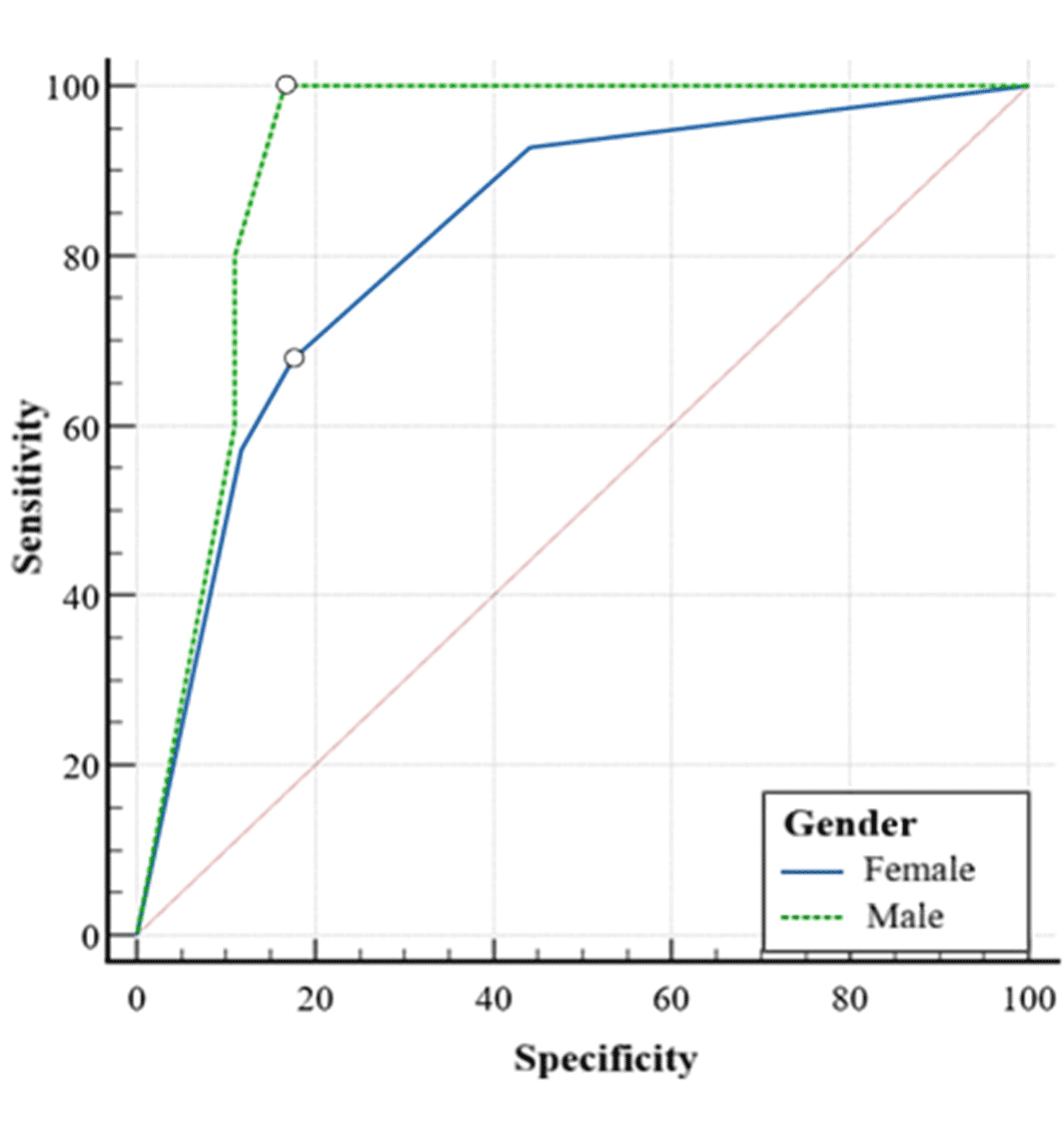
In a multivariate logistic regression model, where the dependent variable was the presence of probable PTSD, and the predictors were the presence of clinically significant depression according to PHQ-9 and clinically significant anxiety for GAD-7, both factors remained independent predictors of PTSD (GAD-7; OR=7.54; 95% CI 2.43-23.49; p=0.0005; PHQ-9; OR=5.64; 95% CI 1.76-18.10; p=0,004). The model was characterized by high discriminatory ability (ROC-AUC=0.85; 95% CI 0.76-0.92) (Fig. 2).
The multicollinearity assessment did not reveal problematic relationships between predictors: all variance inflation factor (VIF) values were <3, including for PHQ-9 (VIF=2.25) and GAD-7 (VIF=2.08), which confirms the stability of estimates in multivariate models.
After gender correction, it was found that for male, the model as a whole remains reliable, but clinically significant anxiety and depression cease to be independent predictors. And for female, it remains reliable, but slightly loses its discriminatory ability (ROC-AUC=0.82; 95% CI 0.70-0.91).
However, comparing the models, no significant differences were revealed (p=0.21).
In our sample of medical students under prolonged wartime stress, the prevalence of probable PTSD at PCL-5 ≥33 was 38.8%, while clinically significant depression (PHQ-9 ≥10) was 50.6% and clinically significant anxiety (GAD-7 ≥10) was 36.5%. Such indicators are comparable to data from armed conflict zones, but show more pronounced post-traumatic symptoms and lower anxiety indicators compared to some of the samples. Thus, among medical students in Sudan during the military conflict, 58.3% reported depression, anxiety 51.5% and PTSD 27.1% [5]. In a Ukrainian study at the Ternopil National Medical University, after ~18 months of war, the prevalence of anxiety was recorded on the DASS-21 and IES-R scales of 59.6%, depression 58.8%, as well as significant symptoms of PTSD among 44.2% of those studied, which demonstrates similar indicators of PTSD symptoms to our results, but with higher rates of depression and anxiety, which is probably associated with the initial stage of the military conflict [7].
Substantially higher rates were observed in a study from the Gaza Strip: in a sample of 339 medical students during the war, 63.4% reported PTSD as well as very high levels of depressive and anxiety symptoms [6]. This can be justified by the fact that the intensity of stress and the immediacy of traumatization are much higher there.
The results of a study of medical students in Turkey after the Great Anatolian Earthquake: PTSD 38.9%, anxiety 28.7%, depression 21.1%. The results are similar to ours in terms of PTSD rates, but significantly lower rates of depression and anxiety, which may reflect the difference between an acute catastrophe and prolonged war stress [3].
The key meaningful result of our work is a pronounced comorbidity of PTSD symptoms with depression and anxiety. At the category level, the presence of clinically significant depression and anxiety significantly increases the likelihood of belonging to the PTSD group. This pattern is consistent with current evidence that PTSD in students and young adults under stressful conditions is rarely isolated and often coexists with depressive and anxiety symptoms. At the same time, it is important that in our analysis, the association of PTSD with cumulative traumatization persists even when controlling for the "affective factor", meaning PTSD is not reduced to general distress [3].
CONCLUSION
- Medical students in the context of a prolonged military conflict showed a high level of symptoms of depression, anxiety and post-traumatic stress disorder, which indicates a significant psychoemotional burden in this population.
- Posttraumatic stress disorder symptoms in medical students are often combined with clinically significant depressive and anxiety manifestations, which confirms the presence of pronounced comorbidity of affective and posttraumatic symptoms.
- Cumulative traumatic exposure is significantly associated with the severity of posttraumatic stress disorder symptoms, depression and anxiety, with the association between traumatic experiences and posttraumatic stress disorder symptoms persisting even after controlling for general affective distress.
- Despite the high prevalence of clinically significant mental symptoms, most medical students do not seek professional psychiatric care, indicating that there are significant barriers to receiving mental health care in this group.
- The results of the study indicate the need for a systematic approach to identifying posttraumatic stress disorder, depression and anxiety through regular screening, as well as the development of structured programs of psychoeducational and psychosocial support among applicants for higher medical education in conditions of prolonged stressful load, in particular war stress.
Contributors:
Ogorenko V.V. – conceptualization, project administration, writing – review & editing, supervision;
Kokashynskyi V.O. – conceptualization, investigation, writing – original draft, validation, writing – review & editing, supervision;
Shornikov A.V. – formal analysis, data curation, writing – original draft, visualization;
Makoviichuk O.A. – investigation, resources;
Bakhtin B.I. – investigation, conceptualization.
Funding. This research received no external funding.
Conflict of interests. The authors declare no conflict of interest.
REFERENCES
- Lin Y-K, Saragih ID, Lin C-J, Liu H-L, Chen C-W, Yeh Y-S. Global prevalence of anxiety and depression among medical students during the COVID-19 pandemic: a systematic review and meta-analysis. BMC Psychol. 2024;12:338. doi: https://doi.org/10.1186/s40359-024-01838-y
- Khurshid S, Khurshid S, Toor HK. Burnout as a mental health challenge among medical students in pakistan: a qualitative study of its triggers, impacts, and support needs. BMC Med Educ. 2025;25:1190. doi: https://doi.org/10.1186/s12909-025-07762-y
- Tuygar-Okutucu F, Ceyhun HA. Cumulative trauma and other determinants of post-traumatic stress disorder, anxiety and depression in medical students following the Great Anatolian earthquake in Turkey. Soc Psychiatry Psychiatr Epidemiol. 2025;60:2517-31. doi: https://doi.org/10.1007/s00127-025-02876-6
- Alzahrani A, Keyworth C, Alshahrani KM, Alkhelaifi R, Johnson J. Prevalence of anxiety, depression, and post-traumatic stress disorder among paramedic students: a systematic review and meta-analysis. Soc Psychiatry Psychiatr Epidemiol. 2025;60:563-78. doi: https://doi.org/10.1007/s00127-024-02755-6
- Alfadul ESA, Alrawa SSK, Hemmeda L, Adam AYT, Mohamed Salih Mohamed Nour S, Ebrahim Hamed Saeed N, et al. Effect of military conflict on mental health: a cross-sectional study among the medical students at Khartoum governmental universities, Sudan, 2023. BMJ Open.2025;15:e086495. doi: https://doi.org/10.1136/bmjopen-2024-086495
- Aldabbour B, Abuabada A, Lahlouh A, Halimy M, Elamassie S, Sammour AA-K, et al. Psychological impacts of the Gaza war on Palestinian young adults: a cross-sectional study of depression, anxiety, stress, and PTSD symptoms. BMC Psychol. 2024;12:696. doi: https://doi.org/10.1186/s40359-024-02188-5
- Korda M, Shulhai A, Shevchuk O, Shulhai O, Shulhai A-M. Psychological well-being and academic performance of Ukrainian medical students under the burden of war: a cross-sectional study. Front Public Health. 2025 Jan 6:12:1457026. doi: https://doi.org/10.3389/fpubh.2024.1457026
- Fedchyshyn NO, Shulhai AH, Hantimurova NI, Klishch HI, Hnatyshyn SI, Bilavych HV, et al. Depression, PTSD and psychological distress among Ukrainian youth: The impact of war on mental health. Pol Merkur Lek Organ Pol Tow Lek. 2025;53:620-8. doi: https://doi.org/10.36740/Merkur202505109
- The Universal Declaration on Bioethics and Human Rights. Int Soc Sci J. 2005;57:745-53. doi: https://doi.org/10.1111/j.1468-2451.2005.00592.x
- World Medical Association. World Medical Association Declaration of Helsinki: Ethical Principles for Medical Research Involving Human Participants. JAMA. 2025;333(1):71-4. doi: https://doi.org/10.1001/jama.2024.21972
- Gray MJ, Litz BT, Hsu JL, Lombardo TW. Psychometric Properties of the Life Events Checklist. Assessment. 2004;11:330-41. doi: https://doi.org/10.1177/1073191104269954
- Weigelt A, Kizilhan JI. The Ukrainian version of the Perceived Injustice Questionnaire: A psychometric evaluation. Front Psychiatry. 2024;15:1446724. doi: https://doi.org/10.3389/fpsyt.2024.1446724
- Blevins CA, Weathers FW, Davis MT, Witte TK, Domino JL. The Posttraumatic Stress Disorder Checklist for DSM-5 (PCL-5): Development and Initial Psychometric Evaluation. J Trauma Stress. 2015;28:489-98. doi: https://doi.org/10.1002/jts.22059
- Kohut A, Chaban O. The evaluation of psychometric properties of the Ukrainian Versions of PCL-5, PHQ-9 and GAD-7 scales. Psychosom Med Gen Pract. 2025;10(1):1-8. doi: https://doi.org/10.26766/pmgp.v10i1.597
- Kroenke K, Spitzer RL, Williams JBW. The PHQ-9: Validity of a brief depression severity measure. J Gen Intern Med. 2001;16:606-13. doi: https://doi.org/10.1046/j.1525-1497.2001.016009606.x
- Spitzer RL, Kroenke K, Williams JBW, Löwe B. A brief measure for assessing generalized anxiety disorder: the GAD-7. Arch Intern Med. 2006;166:1092-7. doi: https://doi.org/10.1001/archinte.166.10.1092
- Torres D, Normando D. Biostatistics: essential concepts for the clinician. Dent Press J Orthod. 2021;26:e21spe1. doi: https://doi.org/10.1590/2177-6709.26.1.e21spe1
- Lee SW. Methods for testing statistical differences between groups in medical research: statistical standard and guideline of Life Cycle Committee. Life Cycle. 2022;2:1-8. doi: https://doi.org/10.54724/lc.2022.e1