

 UK
 EN



Putra D.P.1
 Utami D.A.2
Sundari L.P.R.3
Arohman A.S.B.4
Key words: erythropoietin, exercise, physical fitness, hypoxia
Ключові слова: еритропоетин, фізичні вправи, фізична підготовка, гіпоксія
Abstract
Erythropoietin levels rising during exercise is a significant physiological reaction that helps the body adjust to higher oxygen demands. By triggering biochemical pathways sensitive to variations in oxygen levels, physical activity, especially at high intensities or in hypoxic environments, might increase the production of erythropoietin. This adaptive response enhances erythropoiesis, thus improving oxygen transport capacity to meet the increased metabolic demands during exercise. Furthermore, elucidating the molecular pathways responsible for exercise-induced erythropoietin production may provide valuable insights for optimizing exercise interventions in both athletic and clinical settings. The association between exercise and elevated erythropoietin has been studied extensively, but the underlying molecular mechanisms are still unknown. The aim of this study was to determine the effect of physical exercise on human erythropoietin levels. We reviewed several literature databases, including Scopus, PubMed, Web of Science, and Science Direct, for our systematic review investigation. The search was conducted for articles published between 2015 and 2025 that discussed physical exercise and erythropoietin. Using the Scopus, Web of Science, PubMed, and Science Direct databases, 704 published publications were identified. For this systematic review, ten papers meeting the inclusion criteria were selected and reviewed. This study evaluated standard operating procedures using the preferred reporting items for systematic reviews and meta-analyses criteria. Based on 10 reviewed papers, it has been shown that physical exercise can significantly increase erythropoietin levels. Erythropoietin levels have been demonstrated to rise with physical activity. This rise is a natural reaction to physical activity, especially when there is hypoxia. The body's adaptive reaction to the elevated oxygen requirement is this rise. Exercise therefore contributes to the formation of red blood cells and the expansion of oxygen transport capacity.
Реферат
Механізми підвищення рівня еритропоетину під час фізичних вправ: систематичний огляд. Путра Д.П., Утамі Д.А., Сундарі Л.П.Р., Арохман А.С.Б. Підвищення рівня еритропоетину під час фізичних навантажень є важливою фізіологічною реакцією, яка допомагає організму адаптуватися до підвищеної потреби в кисні. Шляхом активації біохімічних шляхів, чутливих до коливань рівня кисню, фізична активність – особливо високої інтенсивності або в умовах гіпоксії – може стимулювати вироблення еритропоетину. Ця адаптивна відповідь посилює еритропоез, покращуючи тим самим здатність транспортування кисню для забезпечення підвищених метаболічних потреб під час тренувань. Окрім того, з'ясування молекулярних механізмів, відповідальних за індуковане фізичними навантаженнями вироблення еритропоетину, може надати цінні дані для оптимізації тренувальних програм як у спортивній, так і в клінічній практиці. Взаємозв'язок між фізичними вправами та підвищеним рівнем еритропоетину досліджувався досить широко, проте основні молекулярні механізми й досі залишаються невідомими. Метою цього дослідження було визначити вплив фізичних вправ на рівень еритропоетину в людини. Для проведення систематичного огляду ми здійснили пошук у кількох літературних базах даних, зокрема Scopus, PubMed, Web of Science та Science Direct. Пошук охоплював статті, опубліковані в період з 2015 до 2025 року, у яких розглядалися фізичні вправи та еритропоетин. За допомогою баз даних Scopus, Web of Science, PubMed і Science Direct було знайдено 704 опубліковані праці. Для цього систематичного огляду було відібрано та проаналізовано десять статей, які відповідали критеріям включення. У цьому дослідженні стандартні операційні процедури оцінювалися згідно з критеріями PRISMA (Preferred Reporting Items for Systematic Reviews and Meta-Analyses). На основі 10 проаналізованих статей було доведено, що фізичні вправи здатні суттєво підвищувати рівень еритропоетину. Рівень еритропоетину демонструє тенденцію до зростання внаслідок фізичної активності. Це зростання є природною реакцією на фізичне навантаження, особливо за умов гіпоксії. Подібне підвищення є адаптивною реакцією організму на підвищену потребу в кисні. Отже, фізичні вправи сприяють утворенню еритроцитів та розширенню здатності транспортування кисню.
Because altitude enables physiological adaptation, athletes frequently engage in physical training there to enhance their physical performance [1]. When oxygen levels fall below average, it's called hypoxia. This condition has drawn attention due to its possible positive physiological consequences and is frequently employed as a means of enhancing physical performance [2]. Long-term exposure to hypoxia, which frequently occurs when arterial oxygen saturation drops below 90%, triggers a variety of physiological responses and adaptations that enhance exercise performance [3]. Over decades of scientific study and athletic practice, numerous strategies for training at high altitudes and hypoxia have been devised.
One of the primary physiological benefits of training in hypoxic environments is an increase in hemoglobin and red blood cell concentration, which is crucial for transferring oxygen from the lungs to the tissues and has a significant influence on enhancing aerobic performance [4]. During exercise, oxygen is transferred from the lung to the muscles via the binding of hemoglobin, an iron-containing protein found in red blood cells [5]. Consequently, hemoglobin mass has a strong association with maximum oxygen consumption and is a valid indicator of blood oxygen-carrying ability [6]. Previous studies have demonstrated that the distinct hypoxic environment at specific altitudes and training load intensities will cause the body to experience a "double" hypoxic stimulation [7]. Erythropoietin (EPO) is one of the vital and advantageous hormones in this system [8].
The vital function of EPO, an evolutionarily conserved hormone mostly produced in the kidney, in erythropoiesis has been well-documented [9]. EPO is a member of the type 1 cytokine superfamily and consists of four α helices formed by 165 amino acids [10]. Because of its high glycosylation rate, EPO generated by kidneys has a plasma half-life of 5-6 hours in humans. The renal tubules' interstitial cells sense relative hypoxia when the red blood cell count falls, and they use a traditional endocrine pathway to release EPO into the bloodstream [9]. Following its migration to the bone marrow, EPO stimulates erythropoiesis via binding to the homodimeric EPO receptor (EPOR) 2 on erythroid progenitors. Small levels of EPO in human serum, controlled by a traditional negative feedback loop, can preserve erythropoiesis homeostasis because of the high affinity of (EPOR) 2 [11].
Many investigations conducted in the last few years have demonstrated that EPO has effects that go far beyond erythropoiesis. EPO has a crucial function in tissue protection and repair at the border surrounding the injury site, where it is produced by numerous tissues under hypoxic, traumatic, or inflammatory conditions [9]. This impact was previously thought to be mediated by reduced apoptosis and suppression of proinflammatory cytokines [12]. Furthermore, previous studies have verified and demonstrated that physical activity or sports training has been found to increase erythropoietin (EPO) in athletes [13]. The exact chemical mechanisms at play, however, are still up for debate and need more research. Thus, the purpose of this study was to ascertain how exercise raised EPO levels and what that meant for people, specifically in terms of enhancing physical performance and ability.
MATERIALS AND METHODS OF RESEARCH
The design of this study was a systematic review conducted in accordance with the Preferred Reporting Items for Systematic Reviews and Meta-Analyses PRISMA 2020 guidelines. The literature search was performed using four electronic databases: PubMed, ScienceDirect, Web of Science, and Scopus. These databases were selected because they provide comprehensive coverage of peer-reviewed publications in the fields of exercise physiology, sports medicine, hematology, and biomedical sciences.
A predefined search strategy was applied across all databases to identify relevant studies investigating the effects of physical exercise on erythropoietin levels in humans. Duplicate records were removed before the screening process using reference management software. Subsequently, all retrieved articles were screened independently based on predefined inclusion and exclusion criteria, and eligible studies were selected for qualitative synthesis. The study selection process followed the PRISMA 2020 flow diagram to ensure transparency and reproducibility throughout the review process.
The inclusion criteria for this study were created considering papers published from 2015 to 2025 that discussed the effects of physical activity on erythropoietin. Furthermore, our analysis did not include publications that did not meet the standards for scientific validity or that were not included in reputable search indexes such as Scopus, Web of Science, Pubmed, or Science Direct.
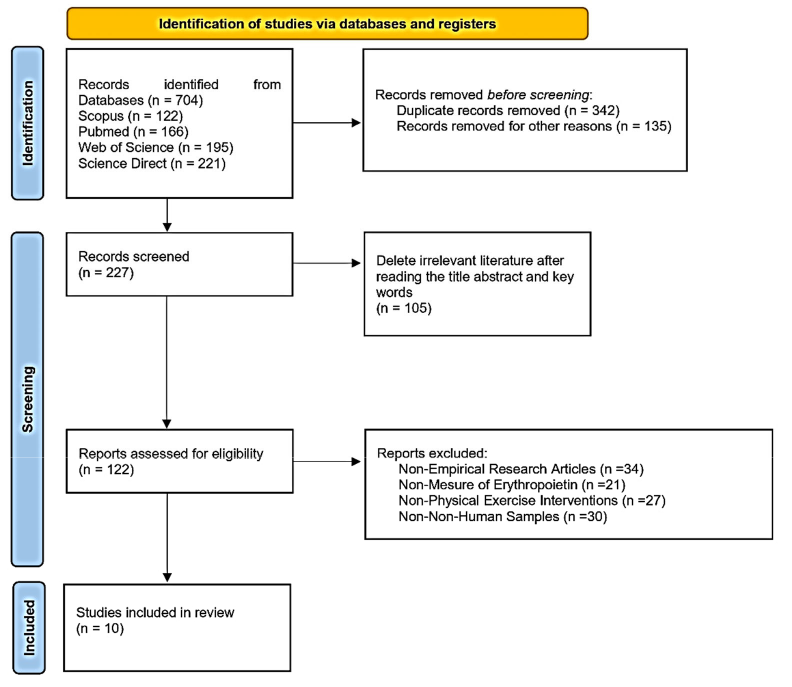
Following preliminary review and approval, each paper's complete text, abstract, and title were added to the Mendeley database. Using the Scopus, Science Direct, Pubmed, and Web of Science databases, 704 papers were located in the first phase. 227 eligible papers were chosen for the second screening stage following the title appropriateness screening. 122 papers were chosen for the third round after the title, abstract, and keywords were examined. Each publication was examined, and we concluded that it satisfied the inclusion criteria, which were as follows: the study had to be unique, the parameter had to be an erythropoietin biomarker, the intervention had to be any kind of physical activity, and the sample had to be human. At this stage, we arranged the things according to their general appropriateness. Following a rigorous review and scrutiny procedure, ten papers that satisfied the inclusion criteria were chosen for study. Following the Preferred Reporting Items for Systematic Reviews and Meta-Analyses (PRISMA) (Fig.) standards was one of the study's operational requirements. Furthermore, every publication complies with the Declaration of Helsinki and research standards.
Ethical approval was not required for this study because it is a literature review based exclusively on previously published data and does not involve human participants, animals, biological specimens, or identifiable personal data.
RESULTS AND DISCUSSION
Author Design Participants Participants Age Intervention Outcome (Montero et al., 2017) [14] Randomized controlled trials 9 healthy, previously untrained young individuals 18-35 years Exercise Program Over the course of eight weeks, each person participates Following a physical activity intervention, EPO levels significantly increased (Riberio et al., 2017) [15] Randomized controlled trials 38 research participants 20 years Exercise Program Weight training sessions included three sets of 12 repetitions and were conducted at an intensity of 60%, 70%, or 80% of the 1-RM. Each training session lasts roughly 30 minutes, with a one-minute break between sets. Every training session was held in the morning, from 8:30 Following a physical activity intervention, EPO levels considerably increased (Dziembowska, Bukowski et al., 2021) [16] Randomized controlled trials 39 athletes 22-23 years Exercise Program 5120.00 (3100.00–6300.00) for athletes undergoing physical training Physical activity is measured in MET × min/week. Athletes engage in high levels Following a physical activity intervention, EPO levels significantly increased (Azadan et al., 2021) [17] Randomized controlled trials 15 participants 31 years Exercise Program 14 participants Following a physical activity intervention, EPO levels significantly increased (Yatsutani et al., 2020) [18] Randomized controlled trials 12 healthy males cycled 21 years Exercise Program For 60 minutes, participants engaged in heat and hypoxia (H+H; fraction of inspired oxygen or FiO2: 14.5%, 32◦C), hypoxia (HYP; FiO2: 14.5%, 23◦C), and normoxia (NOR; FiO2: 20.9%, 23◦C) exercise at a constant workload (60% of their power output relative to their maximal oxygen intake in each conditions) Following a physical activity intervention, EPO levels significantly increased (Weng et al., 2021) [19] Randomized controlled trials 6 swimmers 20 years Exercise Program Every week, swimmers train for ten sessions. Land training, which consists of squats, running, bench presses, pull-ups, and other exercises, is done two to three times a week for an hour each. There are other types of in-water training, including elastic band training, which is done twice a week for thirty minutes each session EPO levels increased significantly after physical exercise intervention (Park et al., 2022) [20] Randomized controlled trials 20 amateur Korean female runners 19-29 years Exercise Program Based on their body composition and endurance training performance, interval training under normoxic conditions A 120-minute training session that included a 20-minute warm-up, 60-minute interval training, and a 20-minute cool-down was completed by all participants. For six weeks, the training course was held three days EPO levels increased significantly after physical exercise intervention (Fernandez-Lazaro et al., 2022) [3] Randomized controlled trials 24 male athletes 25-26 years Exercise Program To improve performance, athletes add altitude training to their regular training regimen. Intermittent hypoxic exercise (IHE) in addition to altitude training for eight weeks EPO levels increased significantly after physical exercise intervention (Wang et al., 2022) [21] Randomized controlled trials 6 male cross-country skiers participated 21 years Exercise Program Including travel time from Following a treadmill and a gas analyzer (COMED Quark CPET, Italy), the exercise load test was conducted following the Bruce protocol. The incline was increased by 2% every three minutes after the initial 1.7 mph speed and 10% incline. The pace was then increased from 0.8 EPO levels increased significantly after physical exercise intervention (Man et al., 2021) [2] Randomized controlled trials 10 endurance-trained athletes 20 years Exercise Program The athletes trained for the following three periods: during the first phase, the participants trained for 21 days at an altitude of about 2000 meters The participants in the second phase followed the same training regimen by the sea in Mamaia-Constant (~0 m) on the Black Sea coast. Lastly, the third training cycle was held EPO levels increased significantly after physical exercise intervention
in 25 60-minute sessions of supervised bicycle ergometry (Monark E839) in our lab. During this time, people are trained three to four times a week, depending on their schedule
to 11:00 AM
of physical exercise
in the early season
in a different group underwent three 30-minute high-intensity cycling sessions following the administration of either
a placebo, the non-preferential β1 + β2 antagonist nadolol,
or the β1-adrenergic receptor (AR) antagonist bisoprolol
and hypoxic training groups were suitable for interval training under hypobaric hypoxia conditions
at a simulated altitude of 3000 m.
a week. For twenty minutes,
the warm-up and cool-down phases were conducted
at 60% of Hrmax
the high-altitude camp to the laboratory, exercise performance was assessed three days prior
to and four days following the high-altitude field training.
to 0.9 mph until the treadmill speed could no longer be maintained and the maximum heart rate exceeded 90% of the target heart rate (THR)
in Piatra Arsă.
at an altitude of about
600 meters in Blaj
The purpose of this study was to determine the effect of physical exercise on increasing EPO levels. The results showed that physical exercise significantly increased EPO levels. This is consistent with a previous study in which individuals received an ergometry exercise intervention of 25 sessions over 8 weeks, with three to four sessions per week, which significantly increased EPO levels [14]. According to additional study, training with three sets of 12 repetitions and weight training at intensities of 60%, 70%, or 80% of one repetition maximum significantly increases EPO levels [15]. Other research conducted on athletes undergoing early season training at high levels also showed a significant increase in EPO levels [16].
In a prior study, fourteen individuals completed three 30-minute high-intensity cycling sessions, and the results demonstrated a substantial effect on raising EPO levels [17]. Exercise in hypoxic environments significantly increases EPO levels, according to other research findings [18]. According to earlier studies, swimmers who had completed 10 training sessions per week in addition to land training performed squats, runs, bench presses, pull-ups, and other exercises two to three times a week for an hour each. Twice a week, for 30 minutes each, different types of in-water training were conducted, including elastic band exercise. The study's findings demonstrated a noteworthy influence on rising EPO levels [19].
A 120-minute training program that includes a 20-minute warm-up, 60 minutes of interval training, and a 20-minute cool-down has been shown to be effective when conducted under hypoxic conditions. In addition, the training course runs for six weeks, three days a week. The findings demonstrated that this training had a major effect on EPO levels [20]. According to the findings of another study, athletes who trained for eight weeks at high altitudes had a rise in EPO levels, which may have led to an improvement in their physical performance [3]. The results of other studies demonstrate that exercise at high elevations significantly increases EPO levels [21]. The altitude at which athletes participated in study activities for 21 days was also found to have a substantial effect on raising EPO levels [2]. So, various studies have clearly proven and shown that physical exercise has an impact and influence on increasing EPO levels which will affect athletes' physical performance and aerobic capacity.
Physiological Mechanisms of Physical Exercise in Increasing Erythropoietin Levels
To shed light on the beneficial effects of exercise on EPO levels, it is crucial to talk about and thoroughly investigate the molecular mechanisms behind exercise-induced EPO increase. Exercise and hypoxia are both powerful metabolic stresses. The total blood aggregation rate is greatly increased when these elements are combined. Exercise stimulates the sympathetic nervous system and the HPA axis [22]. The body will also contract its muscles 100 times faster than normal [23]. Energy requirements rise sharply and quickly after this increase in shrinkage [24]. The body searches for ways to obtain oxygen and distribute it throughout the body more rapidly and thoroughly through physiological processes because physical exertion causes hypoxia, or a lack of oxygen [25]. The body's hypoxic phase will cause HIF-1α to be expressed genetically [26]. Furthermore, a steady HIF-1α component is essential for the activation of downstream target genes involved in a number of biological activities, including angiogenesis, glucose metabolism, cell proliferation, and survival. This is accomplished by attaching to the HRE and then transferring to the nucleus to create a heterodimer with HIF-1β [27].
Under the control of HIF-1α, hypoxia can increase EPO secretion [28]. However, proinflammatory factors as MPO, TNF-α, IL-1, or IL-6 can rise in response to acute exercise or severe hypoxia circumstances. Hematological adaptability and the EPO response may be impeded by these situations [29]. A key component of this reaction is hematologic adaptation to extended hypoxia and breathing. The hematologic response is the result of elevated hemoglobin (Hb) and red blood cell levels caused by enhanced EPO production by the kidneys [26]. The body will try to preserve homeostasis while providing energy to the cells if hypoxia is induced [6]. The body will react to hypoxia by producing more erythropoietin [6]. Erythropoiesis is triggered by this hormone [30]. Erythrocyte levels will rise as a result of the body going through this erythropoiesis mechanism [30]. The distribution of oxygen to the cells is increased when the hemoglobin level rises in tandem with the erythrocyte level [31].
Together with red blood cells, hemoglobin is crucial for supplying oxygen to all bodily tissues [32]. The capacity of the heart, lungs, and blood to carry out physical exercise is significantly impacted by VO2max [8]. Therefore, improving the blood's capacity to bind oxygen can also raise VO2max while exercising [8]. Increased blood EPO levels speed up the rate and quantity of colony-forming units (CFU-E) that differentiate into red blood cells, which in turn promotes erythropoiesis in the bone marrow. Increased red blood cell mass has the effect of reducing the stimulation for the generation of EPO. When there is a higher demand for oxygen, such as during exercise, inflammation, or heat, the amount of oxygen in tissue decreases, a condition known as metabolic hypoxia [33]. Hypoxia is thought to be the most significant stimulus for EPO release, and EPO mRNA expression is strongly correlated with renal oxygen concentration [34].
According to recent studies, elite athletes' EPO concentrations peak after six days of intermittent hypoxia exposure [35]. Prior research also demonstrated a connection between erythropoiesis and muscle mass [36]. The idea that EPO improves exercise performance by activating EPO receptor subtypes in non-hematopoietic tissues, such as skeletal muscle, is supported by certain data [16]. According to recent research, endogenous EPO regulates skeletal muscle mitochondrial biogenesis through EPO receptors on myocytes [37]. Nijholt et al. demonstrated that the absence of EPO receptors in non-hematopoietic tissues led to decreased myocyte development and exercise capacity in response to voluntary exercise in mice, as well as poor mitochondrial content in skeletal muscle [37]. Therefore, it can be hypothesized that the kidneys may not be the only source of erythropoietin released into the bloodstream as a result of physical activity; the working skeletal muscles may also be involved, at least in the early phases of exercise [37].
Every physical activity session helps to release androgens, cortisol, and noradrenaline [38], It is a hormone that promotes the release of EPO, which increases the bone marrow's erythropoietic activity [34]. By raising the quantity of EPO receptors, testosterone can potentially have a direct impact on erythroblasts [38]. Recent research has also shown that noradrenaline interacts intricately with the bone marrow, which explains why the erythropoietic response depends on exercise length and intensity as well as the stress reaction that goes along with it [38, 39]. Review studies reveal that while prolonged and intense physical exertion (such as ultramarathon running) temporarily raises EPO levels in both trained and untrained men, short-term exercise has no discernible effect on EPO levels [14]. Due to a significant increase in physical effort relative to the person's typical level of physical activity, a brief increase in EPO concentration seems to have adaptive importance.
Strength and Limitations. This systematic review has the advantage of focusing solely on randomized controlled trials, the most trustworthy source of scientific data and removing the potential for ambiguous cause-and-effect correlations. Additionally, the collected samples are human-focused, exhibit consistent data, and aren't mixed with samples from other categories, such as animal samples.
We acknowledge that this systematic review has limitations because it only examined the detailed relationship between exercise and erythropoietin levels. Although the researchers acknowledge the intricacy of the physiological processes taking place within the body, their discussion of physiological reactions and their mechanisms may seem in-depth. Experimental research is required to investigate other biomarkers, such as how erythropoietin levels occur during exercise. Additionally, a thorough analysis of the differences between high- and low-intensity exercise is required; Consequently, more research is advised to address this matter.
CONCLUSIONS
- According to several related studies we found, regular exercise has been shown to significantly increase human erythropoietin levels.
- Erythropoietin levels during exercise play an important role in increasing erythropoiesis and improving physical performance in humans or athletes.
Contributors:
Putra D.P. – visualization, writing – original draft;
Utami D.A. – conceptualization, writing – review & editing, data curation;
Sundari L.P.R. – conceptualization, writing – original draft;
Arohman A.S.B. – conceptualization, writing – original draft.
Acknowledgement. We would like to express our gratitude that this publication has received funding from Universitas Airlangga.
Funding. This research received no external funding.
Conflict of interests. The authors declare no conflict of interest.
REFERENCES
- Dragos O, Alexe DI, Ursu EV, Alexe CI, Voinea NL, Haisan PL, et al. Training in Hypoxia at Alternating High Altitudes Is a Factor Favoring the Increase in Sports Performance. Healthcare (Basel). 2022;10(11):2296. doi: https://doi.org/10.3390/healthcare10112296
- Man MC, Ganera C, Bărbuleț GD, Krzysztofik M, Panaet AE, Cucui AI, et al. The modifications of haemoglobin, erythropoietin values and running performance while training at mountain vs. Hilltop vs. Seaside. Int J Environ Res Public Health. 2021 Sep 8;18(18):9486. doi: https://doi.org/10.3390/ijerph18189486
- Fernández-Lázaro D, Mielgo-Ayuso J, Santamaría G, Gutiérrez-Abejón E, Domínguez-Ortega C, García-Lázaro SM, et al. Adequacy of an Altitude Fitness Program (Living and Training) plus Intermittent Exposure to Hypoxia for Improving Hematological Biomarkers and Sports Performance of Elite Athletes: A Single-Blind Randomized Clinical Trial. Int J Environ Res Public Health. 2022 Jul 26;19(15):9095. doi: https://doi.org/10.3390/ijerph19159095
- Breda FL, Manchado-Gobatto FB, de Barros Sousa FA, Beck WR, Pinto A, Papoti M, et al. Complex networks analysis reinforces centrality hematological role on aerobic-anaerobic performances of the Brazilian Paralympic endurance team after altitude training. Sci Rep. 2022 Jan 21;12(1):1148. doi: https://doi.org/10.1038/s41598-022-04823-w
- Poole DC, Musch TI. Capillary-Mitochondrial Oxygen Transport in Muscle: Paradigm Shifts. Function (Oxf).2023 Mar 16;4(3):zqad013. doi: https://doi.org/10.1093/function/zqad013
- Nagel MJ, Jarrard CP, Lalande S. Effect of a single session of intermittent hypoxia on erythropoietin and oxygen-carrying capacity. Int J Environ Res Public Health. 2020 Oct 4;17(19):7257. doi: https://doi.org/10.3390/ijerph17197257
- Hobbins L, Girard O, Gaoua N, Hunter S. Acute psycho-physiological responses to perceptually regulated hypoxic and normoxic interval walks in overweight-to-obese adults. J Sci Med Sport. 2021 May;24(5):481-7. doi: https://doi.org/10.1016/j.jsams.2020.11.011
- Ayubi N, Wibawa JC, Aljunaid M. Physical Exercise at High Altitudes Increases Erythropoietin Hormone Secretion: A Systematic Review. Al-Rafidain J Med Sci. 2024 Jul 6;7(1):29-33. doi: https://doi.org/10.54133/ajms.v7i1.1031
- Peng B, Kong G, Yang C, Ming Y. Erythropoietin and its derivatives: from tissue protection to immune regulation. Cell Death Dis. 2020 Feb 3;11(2):79. doi: https://doi.org/10.1038/s41419-020-2276-8
- Brines M, Cerami A. The Receptor That Tames the Innate Immune Response. Mol Med. 2012 May 9;18(1):486-96. doi: https://doi.org/10.2119/molmed.2011.00414
- Krzyzanski W, Wyska E. Pharmacokinetics and pharmacodynamics of erythropoietin receptor in healthy volunteers. Naunyn-Schmied Arch Pharmacol. 2008;377:637-45. doi: https://doi.org/10.1007/s00210-007-0225-z
- Brines M, Cerami A. Erythropoietin-mediated tissue protection: reducing collateral damage from the primary injury response. J Intern Med. 2008 Nov;264(5):405-32. doi: https://doi.org/10.1111/j.1365-2796.2008.02024.x
- Płoszczyca K, Langfort J, Czuba M. The Effects of Altitude Training on Erythropoietic Response and Hematological Variables in Adult Athletes : A Narrative Review. Front2018 Apr 11;9:375. doi: https://doi.org/10.3389/fphys.2018.00375
- Montero D, Breenfeldt-Andersen A, Oberholzer L, Haider T, Goetze JP, Meinild-Lundby AK, et al. Erythropoiesis with endurance training : dynamics and mechanisms. Am J Physiol Regul Integr Comp Physiol. 2017 Jun 1;312(6):R894-R902. doi: https://doi.org/10.1152/ajpregu.00012.2017
- Ribeiro F, Ribeiro IP, Gonçalves AC, Alves AJ, Melo E, Fernandes R, et al. Effects of resistance exercise on endothelial progenitor cell mobilization in women. Sci Rep.2017 Dec 19;7(1):17880. doi: https://doi.org/10.1038/s41598-017-18156-6
- Dziembowska I, Wójcik M, Bukowski J, Żekanowska E. Physical Training Increases Erythroferrone Levels in Men. Biology.2021;10(11):1215. doi: https://doi.org/10.3390/biology10111215
- Azadan RJ, Agha NH, Kunz HE, Baker FL, Mylabathula PL, Ledoux TA, et al. The effects of normoxic endurance exercise on erythropoietin (EPO) production and the impact of selective β 1 and non – selective β 1 + β 2 adrenergic receptor blockade. Eur J Appl Physiol. 2021 May;121(5):1499-511. doi: https://doi.org/10.1007/s00421-020-04558-4
- Yatsutani H, Mori H, Ito H, Hayashi N, Girard O, Goto K. Endocrine and Metabolic Responses to Endurance Exercise Under Hot and Hypoxic Conditions. Front Physiol.2020 Aug 19;11:932. doi: https://doi.org/10.3389/fphys.2020.00932
- Weng X, Lin J, Yuan Y, Lin B, Huang W, Tin HT, et al. Intermittent Hypoxia Exposure Helps to Restore the Reduced Hemoglobin Concentration During Intense Exercise Training in Trained Swimmers. Front Physiol. 2021 Nov 29;12:736108. doi: https://doi.org/10.3389/fphys.2021.736108
- Park HY, Jung WS, Kim SW, Kim J, Lim K. Effects of Interval Training Under Hypoxia on Hematological Parameters, Hemodynamic Function, and Endurance Exercise Performance in Amateur Female Runners in Korea. Front2022 May 18;13:919008. doi: https://doi.org/10.3389/fphys.2022.919008.
- Wang JC, Yim KT, Choi YC. Effects of LHTH Training at 1600 m on Exercise Performance, Complete Blood Count and Erythropoietin: a case study of South Korean Elite Male Cross-Country Skiers. Journal of Men's Health. 2022;18(9):1-9. doi: https://doi.org/10.31083/j.jomh1809187
- Daniela M, Catalina L, Ilie O, Paula M, Daniel-Andrei I, Ioana B. Effects of Exercise Training on the Autonomic Nervous System with a Focus on Anti-Inflammatory and Antioxidants Effects. Antioxidants (Basel). 2022 Feb 10;11(2):350. doi: https://doi.org/10.3390/antiox11020350
- McKenna MJ, Renaud JM, Ørtenblad N, Overgaard K. A century of exercise physiology: effects of muscle contraction and exercise on skeletal muscle Na+,K+-ATPase, Na+ and K+ ions, and on plasma K+ concentration-historical developments. Eur J Appl Physiol. 2024 Mar;124(3):681-751. doi: https://doi.org/10.1007/s00421-023-05335-9
- Liepinsh E, Makarova E, Plakane L, Konrade I, Liepins K, Videja M, et al. Low-intensity exercise stimulates bioenergetics and increases fat oxidation in mitochondria of blood mononuclear cells from sedentary adults. Physiol2020 Jun;8(12):e14489. doi: https://doi.org/10.14814/phy2.14489
- Drouin PJ, Liu T, Lew LA, McGarity-Shipley E, Tschakovsky ME. The ‘normal’ adjustment of oxygen delivery to small muscle mass exercise is not optimized for muscle contractile function. J Physiol. 2023 Feb;601(4):783-99. doi: https://doi.org/10.1113/JP283933
- Macarlupu JL, Marchant D, Jeton F, Villafuerte F, Richalet JP, Voituron N. Effect of exercise training in rats exposed to chronic hypoxia: Application for Monge’s disease. Physiol 2021;9(7):e14750. doi: https://doi.org/10.14814/phy2.14750
- Kierans SJ, Taylor Regulation of glycolysis by the hypoxia-inducible factor (HIF): implications for cellular physiology. J Physiol. 2021;599:23-37. doi: https://doi.org/10.1113/JP280572
- Yulfadinata A, Ayubi N, Cahyanto Wibawa J, Zulfikar Rizki A. The Effect of Physical Exercise in INcreasing Hypoxia-Inducible Factor-1Alpha: A Systematic Review. Medicni Perspekt. 2025;6:182-92. doi: https://doi.org/10.26641/2307-0404.2025.3.340762
- Morceau F, Dicato M, Diederich M. Regarding Molecular Mechanisms of Erythropoiesis. Mediators Inflamm.2009;2009:405016. doi: https://doi.org/10.1155/2009/405016
- Bhoopalan SV, Huang LJs, Weiss MJ. Erythropoietin regulation of red blood cell production : from bench to bedside and back. F1000Research. 2025;9:1-17. doi: https://doi.org/10.12688/f1000research.26648.1
- Sepriadi, Jannah K, Eldawaty. The effect of jogging exercise to improve hemoglobin levels. J Phys Conf2020;1481(1):012028. doi: https://doi.org/10.1088/1742-6596/1481/1/012028
- Eltonsy S, Dufour Doiron M, Simard P, Jose C, Sénéchal M, Bouchard DR, et al. Effects of the combination of metformin and exercise on glycated hemoglobin, functional capacity, lipid profile, quality of life, and body weight. J Int Med Res. 2019 Mar;47(3):1131-45. doi: https://doi.org/10.1177/0300060518817164
- Elayyan A. Case Report Erythropoietin and physical exercise. Direct Res J Heal Pharmacol. 2013;1(1):1-4. Available from: https://directresearchpublisher.org/drjhp/files/2013/10/Elayyan.pdf
- Lobigs LM, Sharpe K, Garvican-Lewis LA, Gore CJ, Peeling P, Dawson B, et al. The athlete’ s hematological response to hypoxia : A meta- analysis on the influence of altitude exposure on key biomarkers of erythropoiesis. Am J Hematol. 2018 Jan;93(1):74-83. doi: https://doi.org/10.1002/ajh.24941
- Kasperska A, Zembron-lacny A. The effect of intermittent hypoxic exposure on erythropoietic response and hematological variables in elite athletes. Physiol Res. 2020;69:283-90. doi: https://doi.org/10.33549/physiolres.934316
- Rundqvist H, Rullman E, Sundberg CJ, Fischer H, Eisleitner K, Ståhlberg M, et al. Activation of the erythropoietin receptor in human skeletal muscle. Eur J Endocrinol. 2009 Sep;161(3):427-34. doi: https://doi.org/10.1530/EJE-09-0342
- Nijholt KT, Meems LMG, Ruifrok WPT, Maass AH, Yurista SR, Pavez-Giani MG, et al. The erythropoietin receptor expressed in skeletal muscle is essential for mitochondrial biogenesis and physiological exercise. Pflugers2021 Aug;473(8):1301-13. doi: https://doi.org/10.1007/s00424-021-02577-4
- Luccia TPB, Natali JES, Moreira A, Chaui-Berlinck JG, Bicudo JEPW. Bouts of exercise elicit discordant testosterone: cortisol ratios in runners and non-runners. ArchEndocrinol 2018 Jun;62(3):325-31. doi: https://doi.org/10.20945/2359-3997000000042
- Hayes LD, Grace FM, Baker JS, Sculthorpe N. Exercise-Induced Responses in Salivary Testosterone, Cortisol, and Their Ratios in Men: A Meta-Analysis. Sports Med. 2015 May;45(5):713-26. doi: https://doi.org/10.1007/s40279-015-0306-y