

 UK
UK  EN
EN 

Yovhandra Ockta1
 Irmantara Subagio2
Muhamad Ichsan Sabillah2
Nuridin Widya Pranoto *3
Danny Eka Wahyu Saputra4
Ryan Nur Fadzillah4
Puji Asmawati5
Irmantara Subagio2
Muhamad Ichsan Sabillah2
Nuridin Widya Pranoto *3
Danny Eka Wahyu Saputra4
Ryan Nur Fadzillah4
Puji Asmawati5
Key words: futsal, muscle fatigue, playing performance, physical condition
Ключові слова: футзал, м'язова втома, ігрова ефективність, фізичний стан
Abstract
This study investigates the impact of muscle fatigue on the physical condition and playing performance of futsal players, particularly focusing on decision-making, ball control, and technical skills under fatigue. Ten futsal players from Star Futsal Club (aged 17-25) participated in the study. Player performance was assessed using the Game Performance Evaluation Tool (GPET), which measured on-the-ball attacker and support actions, while physical condition was evaluated through shuttle run, 30-meter sprint, and vertical jump tests. The results showed a decline in performance after fatigue was induced. Specifically, the on-the-ball attacker score decreased from a pre-test mean of 81.00 to 71.75 post-test, and the support score dropped from 61.00 to 47.50. In terms of physical condition, the shuttle run time increased from a mean of 17.07 to 17.62 seconds, the 30-meter sprint time increased from 4.43 to 4.56 seconds, and vertical jump height decreased from 52.60 cm to 51.10 cm. Despite these observable declines, statistical analysis using paired samples t-tests revealed no significant differences: for player performance, t=5.353, df=1, p=0.118, and for physical condition, t=0.437, df=2, p=0.705. These findings suggest that muscle fatigue negatively impacts futsal players’ performance, particularly decision-making, speed, and technical execution, but the changes were not statistically significant, possibly due to the small sample size. The study highlights the importance of proper training load management and recovery strategies to optimize futsal performance. Further research with larger samples is needed to confirm these findings and better understand the effects of fatigue.
Реферат
Вплив м'язової втоми на ігрову продуктивність та фізичний стан футзалістів. Окта Йо., Субагіо І., Сабіллах М.І., Праното Н.В., Сапутра Д.Е.В., Фадзіллах Р.Н., Асмаваті П. Це дослідження вивчає вплив м'язової втоми на фізичний стан та ігрову ефективність гравців футзалу, зокрема на ухвалення рішень, контроль м’яча та технічні навички в умовах втоми. У дослідженні взяли участь десять футзалістів з клубу «Star Futsal» (вік 17-25 років). Оцінювання ефективності гравців здійснювалася за допомогою Інструменту оцінки ігрової ефективності (GPET), який вимірював дії гравців з м'ячем в атакуючих та підтримуючих ситуаціях, тоді як фізичний стан оцінювався за допомогою тестів на біг на шатл-руні, спринт на 30 метрів та вертикальний стрибок. Результати показали зниження ефективності після індукованої втоми. Зокрема, оцінка дій з м’ячем в атаці знизилася із середнього значення 81,00 до 71,75 після тесту, а оцінка підтримки – з 61,00 до 47,50. Щодо фізичного стану, час на шатл-руні збільшився з 17,07 до 17,62 секунди, час спринту на 30 метрів зріс з 4,43 до 4,56 секунди, а висота вертикального стрибка зменшилася з 52,60 см до 51,10 см. Незважаючи на ці спостережувані зниження, статистичний аналіз за допомогою парних t-тестів не виявив значущих відмінностей: для ефективності гравців t=5,353, df=1, p=0,118, і для фізичного стану t=0,437, df=2, p=0,705. Ці результати вказують на те, що м'язова втома негативно впливає на ефективність футзалістів, зокрема на ухвалення рішень, швидкість і технічне виконання, однак зміни не були статистично значущими, що, можливо, пояснюється малим розміром вибірки. Дослідження підкреслює важливість належного управління навантаженням і стратегій відновлення для оптимізації ефективності футзалу. Необхідні подальші дослідження з більшими вибірками для підтвердження цих висновків і кращого розуміння впливу втоми.
Today's athletes need external support to make progress in their sport. Sports science knowledge is one of the aspects that contribute to sports achievement. Combining several broad and interrelated scientific areas, sports science aims to enhance athlete performance and support coaches in their training [1, 2, 3]. Futsal is a ball game played by two teams, each consisting of five people, and played indoors [4, 5]. In general, the basic techniques in futsal are not much different from football. However, several basic techniques need to be done with special skills. The basic techniques in the game of futsal that must be mastered by every player include controlling the ball, passing, dribbling, and shooting [6, 7]. To be successful in futsal, players need to constantly be in top physical shape and work on improving their skills and accomplishments [8, 9]. In a variety of sports, the development of physical condition is fundamental to technical, tactical, and mental preparation [10, 11]. The setting up of physical conditions, strategies, tactics, and psychology is all related to one another. In sports activities, if your physical condition is not good, your technical, tactical, and mental abilities will result in less-than-optimal performance [12]. Good physical exercise is performed regularly, taking into account the body's capabilities and the appropriate amount of exercise [13, 14]. This requires physical, technical, and tactical training over a long period with an increasing workload, so it is hoped that players will develop good physical condition, mental strength, and technical skill [15].
Optimal physical condition is needed to combine the technical, tactical, and mental skills of players on the playing field. This is the basis that must be considered in efforts to achieve maximum athlete performance [16]. Every sporting activity contains elements of strength, duration, speed, and complex movements that require joint expansion [17]. This shows that to improve physical condition, the components of physical condition must be developed. Apart from that, the game of futsal requires players to play by moving the ball quickly, attacking, defending, and circulating the game without the ball or having the right time to make decisions [18]. Players must also master basic techniques such as dribbling, passing, control, chipping, and shooting. Basic techniques are very important to support playing performance on the field. There are various fundamental elements that contribute to developing physical fitness. Regarding the idea of muscular condition, the fundamental elements are endurance, strength, explosive power, speed, flexibility, agility, balance, and coordination [19, 20]. In futsal, the basic physical conditions that are dominant and must be possessed are speed, agility, and endurance because the characteristics of the game of futsal require these three components [21]. Therefore, players must be able to improve these abilities through physical training, as well as technical and tactical exercises, to achieve maximum performance. However, there is an effect of this training, namely that it will cause the players to experience fatigue. Training programs that are carried out progressively and continuously on players and exceed their limits will cause muscle fatigue. Over a long period, the muscles will eventually lose their ability to respond or contract due to fatigue. Apart from that, players can also experience pressure from outside, either environmentally or psychologically, which leads to stress.
Fatigue results in a lack of energy due to excessive physical activity [22]. In addition, physical activity can cause muscle pain and psychological discomfort. Fatigue is a major problem for athletes because it interferes with performance during competitions and can result in a decline in achievement [23]. When a player experiences fatigue, the player can still perform basic techniques such as dribbling, passing, control, and shooting [24]. However, players have difficulty making decisions and providing support, especially during movements without the ball that require speed. It can be concluded that there is an influence of fatigue on futsal playing performance.
Although many studies highlight the importance of recovery in supporting athletic performance, most existing research remains general and has not specifically examined the effectiveness of particular recovery methods in relation to specific sports, training intensity levels, and athletes' psychological conditions. Furthermore, there is a lack of studies that comprehensively integrate both physiological and psychological aspects in designing optimal recovery strategies. The purpose of this study is to investigate the impact of muscle fatigue on futsal players' performance and physical condition. Specifically, it aims to analyze how muscle fatigue affects the execution of fundamental skills such as dribbling, passing, ball control, and shooting, as well as decision-making during the game. Additionally, the study seeks to assess how muscle fatigue influences key physical components like speed, endurance, agility, and strength, and whether it impairs players' ability to maintain optimal physical condition throughout the match. Furthermore, the research will explore the relationship between muscle fatigue levels and overall physical performance decline, and how psychological factors, such as stress, interact with fatigue to affect technical execution and decision-making on the field. By addressing these factors, the study aims to provide a comprehensive understanding of how fatigue impacts futsal performance and inform more effective recovery strategies tailored to the needs of futsal athletes.
MATERIALS AND METHODS OF RESEARCH
This research uses a descriptive approach. Data is classified into two groups: quantitative data, which consists of numbers or symbols, and qualitative data, which is expressed in words. An instrument for assessing playing skills in soccer called the Game Performance Evaluation Tool (GPET) was employed in this study. The GPET evaluates coding decisions and execution in relation to the tactical challenges that players face during games [25]. Prior to participation, all subjects provided written informed consent after receiving a detailed explanation of the study’s objectives, procedures, and potential risks. The study was conducted in accordance with the ethical principles for human research. Ethical approval from the Ethics Committee of the Faculty of Sports Science, Universitas Negeri Surabaya is currently under review, and the protocol number will be provided upon completion of the approval process.
In this research, some aspects are assessed, namely (1) decisions made by players (Tactical Problem); (2) ball position when attacking (On-The Ball Attacker); (3) ball position when not attacking (Off-The Ball Attacker). Shuttle run is a form of agility training. Agility is defined as the body's ability to move and change direction in the shortest possible time without losing balance [26]. Agility is one of the components needed in the game of futsal. When dribbling the ball or trying to break through the opponent's defense, players must have good agility to perform optimally. The tools needed for a shuttle run are (1) Stopwatch; (2) Field; (3) Cones; and (4) Meter.
The study population consisted of ten futsal players selected using purposive sampling from the Star Futsal Club, aged 17-25 years. The selection criteria focused on core players who possessed greater experience and skill and were within the productive age range for optimal performance. The players were divided into two teams. Playing performance was assessed through futsal matches lasting 2×8 minutes, recorded for analysis. Physical condition tests included the shuttle run, 30-meter sprint, vertical jump, and a fatigue test using the Harvard step test for five minutes or until exhaustion, following a metronome pace of 120 beats per minute. Data analysis was conducted using SPSS version 26 (IBM Corp., Chicago, USA; license number WHIQVZYWLARL9JEYQEGDUBLH8Z3ZCJAL3FLXMS98V95TSDYI7FOEXUPRR).
Statistical tests included the Shapiro-Wilk test for normality, Levene’s test for homogeneity of variances, and paired samples t-tests to compare pre-test and post-test results for both player performance and physical condition. The statistical significance level was set at p<0.05. All results were presented as mean ± standard deviation (SD) and displayed in tables and figures for clarity.
RESULTS AND DISCUSSION
The research results were obtained based on observation of the pre-test and post-test results which were carried out by research subjects. The description of the pre-test and post-test data on the influence of muscle fatigue on physical condition and playing performance in futsal players from Star Futsal Club Klaten Regency is as follows:
1. Player performance data
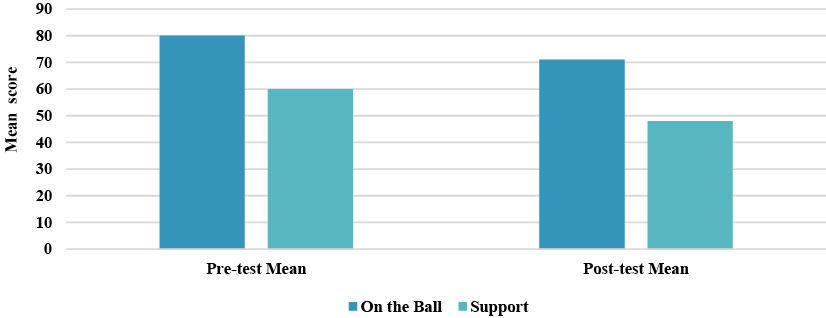
The mean pre-test value for on-the-ball attacker was 81.00, and the post-test value was 71.75. Meanwhile, the mean pre-test value for support was 61.00, and the post-test value was 47.50. The change in the mean values indicates a decrease in the subjects' playing performance. For more details, see Table 1 and Figure 1.
Statistics pre-test post-test on-the-ball attacker support on-the-ball attacker support Std. Dev 58.48 43.49 53.09 37.24 Min 20.00 16.00 15.00 10.00 Max 134.00 104.00 118.00 81.00 Mean 81.00 61.00 71.75 47.50 Note. Scores represent performance assessment points obtained from the observational instrument.
2. Physical condition data
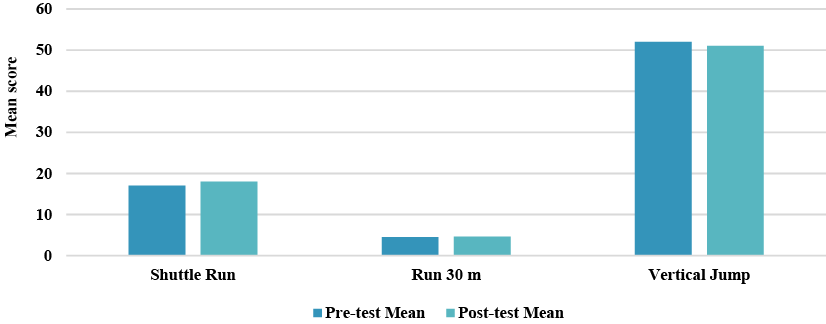
The results display the average, standard deviation, minimum, and maximum values in physical condition tests such as shuttle runs, 30-meter runs, and vertical jumps, based on study data. The data also include pre-test and post-test results. In the shuttle run test, the average pre-test score was 17.07 with a standard deviation of 0.53, and the post-test score was 17.62 with a standard deviation of 0.56. The mean pre-test result for the 30-meter run was 4.43 with a standard deviation of 0.24, and the mean post-test result was 4.56 with a standard deviation of 0.29. For the vertical jump, the pre-test mean was 52.60 with a standard deviation of 6.04, and the post-test mean was 51.10 with a standard deviation of 5.58. These findings suggest that fatigue leads to a decrease in physical condition, as shown by a reduced vertical jump. For more details, see Table 2 and Figure 2.
Statistics pre-test post-test shuttle run (seconds) run 30-meters (seconds) vertical jump centimeters (cm) shuttle run (seconds) run 30-meters (seconds) vertical jump centimeters (cm) Std. Dev 0.53 0.24 6.04 0.56 0.29 5.58 Min 16.24 4.17 44 16.97 4.34 43.00 Max 17.66 5.05 62 18.52 5.33 60.00 Mean 17.07 4.43 52.60 17.62 4.56 51.10 Note. Shuttle run and 30-meter run were measured in seconds (s), while vertical jump was measured in centimeters (cm).
To examine whether there is a statistically significant difference between the pre-test and post-test results, a paired samples t-test was conducted. This test is appropriate for assessing the effect of an intervention or treatment by comparing measurements taken from the same group before and after the intervention. The results of the analysis are presented in Table 3 below.
Measure t df p Pre-Test & Post-Test Player performance data 5.353 1 0.118 Pre-Test & Post-Test Physical condition data 0.437 2 0.705
The analysis revealed that the comparison of player performance data between pre-test and post-test resulted in a t-value of 5.353 with 1 degree of freedom (df) and a p-value of 0.118. For the physical condition data, the test produced a t-value of 0.437 with 2 degrees of freedom and a p-value of 0.705. Despite observable changes in both categories, neither result reached the conventional threshold for statistical significance (p<0.05). The p-values indicate that the differences in player performance and physical condition are not statistically significant. Therefore, based on the paired samples t-test, the observed differences between pre- and post-test scores may be due to chance rather than a meaningful effect of the intervention.
This research is important to conduct because futsal is a high-intensity sport that demands players to maintain optimal physical condition, possess solid technical skills, and make quick tactical decisions on the court. Fatigue, whether caused by intense training or frequent competition, can significantly impact performance in all these areas. In practice, fatigue is often overlooked or considered a normal part of training, but muscular fatigue that is not properly managed can lead to a noticeable decline in both physical and tactical performance. This study makes a valuable contribution by demonstrating how fatigue affects game performance both on-the-ball and off-the-ball actions as well as physical condition (speed, agility, and explosive power) in futsal players.
The findings of this research are supported by several previous studies. For example, researchers who developed the Game Performance Evaluation Tool (GPET) emphasized that decision-making and player positioning are key indicators of tactical performance in football and futsa [27]. This reinforces the validity of using GPET in this study to assess performance under fatigue. Additionally, [8] highlighted that speed, agility, and power are essential components in futsal performance, aligning with this study's focus. Furthermore, [18] stressed the importance of agility in handling the dynamics of futsal, supporting the need to maintain physical condition to optimize technical and tactical execution.
The implications of this study suggest that coaches and sports practitioners must account for fatigue when designing training programs and strategies during matches. Players experiencing fatigue exhibit reduced decision-making capabilities, positional awareness, and muscle power – all of which are crucial in futsal. Therefore, load management and appropriate recovery strategies must be prioritized. However, this study has several limitations. The small sample size of only 10 players from a single futsal club limits the generalizability of the findings. Additionally, psychological factors such as stress and motivation were not thoroughly examined.
This study highlights the impact of fatigue on futsal players' physical and tactical performance, but it has several limitations. The small sample size restricts the generalizability of the findings, and a larger sample would improve the external validity of the results. Additionally, the absence of a control group makes it difficult to determine if the observed performance changes were caused only by fatigue. Psychological factors such as stress and motivation were also not considered, yet they can significantly affect performance. Furthermore, potential learning effects between the pre-test and post-test could have influenced the results, as players may have improved simply due to familiarity with the testing procedure. For sports physiotherapists, it is crucial to monitor fatigue levels, as fatigue not only affects performance but also increases the risk of injury and decreases movement quality. Incorporating proper recovery strategies, such as active recovery exercises and load management practices, is essential. Future research should involve larger, more diverse samples and integrate psychological and physiological measurements to further understand the effects of fatigue and improve recovery and fatigue management strategies.
CONCLUSION
- This study aimed to examine the impact of muscle fatigue on the physical condition and playing performance of futsal players, particularly focusing on decision-making, ball control, and technical skills under fatigue.
- The results show a decrease in players' performance on both on-the-ball and off-the-ball actions in the post-test compared to the pre-test, reflecting the effects of fatigue. Specifically, the mean scores for player performance on "On-The-Ball Attacker" and "Support" decreased after fatigue was induced, indicating a reduction in tactical decision-making and positional awareness during the game.
- The physical condition data also showed a slight decline in performance on the shuttle run, 30-meter run, and vertical jump after the post-test, although these changes were not statistically significant.
- Despite the observable decrease in performance, statistical analysis did not reveal significant differences between the pre-test and post-test results. The lack of statistical significance, especially in the physical condition tests, may be due to the small sample size, which limits the generalizability of the findings.
- This study highlights the significant impact of fatigue on both the physical condition and tactical performance of futsal players. It emphasizes the need for sports physiotherapists to collaborate with coaches in managing training loads and preventing overtraining, as fatigue can impair decision-making, speed, agility, and muscle power. Physiotherapists should implement strategies such as gradual increases in training intensity, active recovery, and proper rest to prevent fatigue buildup. Additionally, personalized recovery plans, including techniques like stretching, massage, and mental relaxation, can help enhance recovery and optimize performance.
Contributors:
Ockta Yo. – validation, resources, writing – review & editing;
Subagio I. – methodology, software, validation, investigation, resources, data curation, supervision, writing – original draft, writing – review & editing;
Sabillah M.I. – conceptualization, validation, formal analysis, resources, writing – original draft, writing – review & editing, visualization, project administration;
Pranoto N.W. – validation, resources, writing – review & editing;
Saputra D.E.W. – validation, resources, writing – review & editing;
Fadzillah R.N. – validation, resources, writing – review & editing;
Asmawati P. – validation, resources, writing – review & editing.
Funding: This research received no external funding.
Conflict of interest: The authors declare no conflict of interest.
REFERENCES
- Fredianto M, Ulfa M, Khairunnisa RA, Chilmi MZ. A Bibliometric Analysis Study on Sport Sciences: Trends and Recommendation for Athletes’ Performance. Int J Kinesiol Sport Sci. 2024;12(3):15-22. doi: https://doi.org/10.7575/10.7575/aiac.ijkss.v.12n.3p.15
- Podrigalo L, Tymchenko K, Perevoznyk V, Semeniv B, et al. Scientific support for strength sports: analysis of scientific resources from the Web of Science Core Collection. Pedagog Phys Cult Sport. 2025;29(1):44-61. doi: https://doi.org/10.15561/26649837.2025.0106
- Otte F, Davids K, Rothwell M, Wood MA, De-Mountfort J. Coach to learn and learn to coach: synergising performance and development in the athlete-coach-environment learning system. Sport Coach Rev. 2024;3:1-25. doi: https://doi.org/10.1080/21640629.2024.2330195
- Gene-Morales J, Saez-Berlanga A, Bermudez M, Flández J, Fritz N, Colado JC. Incidence and prevalence of injuries in futsal: A systematic review of the literature. J Hum Sport Exerc. 2021;16(Proc3):S1467-80. doi: https://doi.org/10.14198/jhse.2021.16.Proc3.63
- Oliveira JP, Sampaio T, Marinho DA, Barbosa TM, Morais JE. Exploring Injury Prevention Strategies for Futsal Players: A Systematic Review. Healthc. 2024;12(14):1-14. doi://doi.org/10.3390/healthcare12141387
- Doewes RI, Elumalai G, Azmi SH. Development of a Test Instrument To Measure the Basic Pass Technique in Futsal. Rev Bras Med do Esporte. 2022;28(5):456-9. doi: https://doi.org/10.1590/1517-8692202228052022_0093
- Klingner FC, Huijgen BCH, Den Hartigh RJR, Kempe M. Technical-tactical skill assessments in small-sided soccer games: A scoping review. Int J Sport Sci Coach. 2022;17(4):885-902. doi: https://doi.org/10.1177/17479541211049532
- Branquinho L, Ferraz R, Teixeira J, Neiva HP, Sortweel A, Forte P, et al. Effects of a Plyometric Training Program in Sub-Elite Futsal Players during Pre-Season Period. Int J Kinesiol Sport Sci. 2022;10(2):42-50. doi: https://doi.org/10.7575/aiac.ijkss.v.10n.2p.42
- Bumrung N, Jansupom C, Rohmansyah NA, Khaothin T, Hiruntrakul A. Acute Effects of Combined High Intensity Interval Training and Step Aerobics Training on Agility in Male Futsal Athletes During the Pre-season. Middle East J Rehabil Heal Stud. 2025;12(3):e158636. doi: https://doi.org/10.5812/mejrh-158636
- Sukamti ER, Budiarti R, Nurfadhila R. Effect of physical conditioning on student basic skills gymnastics. Cakrawala Pendidik. 2020;39(1):207-16. doi: https://doi.org/10.21831/cp.v39i1.29641
- Deng N, Soh KG, Abdullah B, Huang D, Xiao W, Liu H. Effects of plyometric training on technical skill performance among athletes: A systematic review and meta-analysis. PLoS One. 2023;18(7 Jul):1-29. doi: https://doi.org/10.1371/journal.pone.0288340
- Falaahudin A, Suharjana, Sumarjo, Tirtawirya D, Iwandana DT, Padli, et al. Development and Practicality of Android-based Application to Assess the Physical Condition of Young Swimmers. Int J Hum Mov Sport Sci. 2025;13(1):145-54. doi: 10.13189/saj.2025.130116
- Negara JDK, Nuryadi N, Firmansyah H, Gumilar A, Hambali B, Purnomo E, et al. The effect of vo2max on muscle oxygen saturation (SMO2) in University Badminton Athletes. Retos. 2024;61:1184-90. doi: https://doi.org/10.47197/retos.v61.108861
- Wibawa JC, Febrianto N, Fudin MS, Ockta Y, Festiawan R. El mecanismo del ejercicio físico aumenta la glutatión peroxidasa como antioxidante endógeno : una revisión sistemática Authors How to cite in APA Keywords Resumen Palabras clave. Retos. 2025;2025(63):610-9. doi: https://doi.org/10.47197/retos.v63.108856
- Li Y, Li S. Football Player’S Training for Improving Physical Function and Health. Rev Bras Med do Esporte. 2022;28(3):203-6. doi: https://doi.org/10.1590/1517-8692202228032021_0497
- Montella M, Ceciliani A, Morsanuto S, Federici A, Altavilla G. Development of motor skills applied to basketball in the developmental age. J Hum Sport Exerc. 2019;14(Proc4):S835-40. doi: https://doi.org/10.14198/jhse.2019.14.Proc4.46
- Micheo W, Baerga L, Miranda G. Basic principles regarding strength, flexibility, and stability exercises. PM R. 2012;4(11):805-11. doi: https://doi.org/10.1016/j.pmrj.2012.09.583
- Komang Ari Selin, Ni Komang Ayu Juni Antari, I Wayan Sugiritama, Widnyana M. The relationship between agility and dribbling skills among futsal players. Phys Ther J Indones. 2024;5(1):77-80. doi: https://doi.org/10.51559/ptji.v5i1.195
- Görner K, Reineke A. The influence of endurance and strength training on body composition and physical fitness in female students. J Phys Educ Sport. 2020;20(3):2013-20. doi: https://doi.org/10.7752/jpes.2020.s3272
- Ma S, Soh KG, Japar SB, Liu C, Luo S, Mai Y, et al. Effect of core strength training on the badminton player’s performance: A systematic review & meta-analysis. PLoS One. 2024;19(6 Jun):1-22. doi: https://doi.org/10.1371/journal.pone.0305116
- Serrano C, Felipe JL, Garcia-Unanue J, Ibañez E, Hernando E, Gallardo L, et al. Local positioning system analysis of physical demands during official matches in the spanish futsal league. Sensors (Switzerland). 2020;20(17):1-11. doi: https://doi.org/10.3390/s20174860
- Vetrovsky T, Omcirk D, Malecek J, Stastny P, Steffl M, Tufano JJ. Morning fatigue and structured exercise interact to affect non-exercise physical activity of fit and healthy older adults. BMC Geriatr. 2021;21(1):1-10. doi: https://doi.org/10.1186/s12877-021-02131-y
- Skala F, Zemková E. Effects of Acute Fatigue on Cognitive Performance in Team Sport Players: Does It Change the Way They Perform? A Scoping Review. Appl Sci. 2022;12(3):1736. doi: https://doi.org/10.3390/app12031736
- Penichet-Tomas A, Torreblanca-Martínez V, Torreblanca-Martínez S. Acute effect of induced fatigue on passing ability in elite U-19 soccer players. J Phys Educ Sport. 2022;22(2):355-60. doi: https://doi.org/10.7752/jpes.2022.02045
- Gutierrez D, García-López LM. Gender differences in game behaviour in invasion games. Phys Educ Sport Pedagog. 2012;17(3):289-301. doi: https://doi.org/10.1080/17408989.2012.690379
- Morral-Yepes M, Gonzalo-Skok O, Dos Śantos T, Feliu GM. Are change of direction speed and agility different abilities from time and coordinative perspectives? PLoS One. 2023;18(12 Dec):1-14. doi: https://doi.org/10.1371/journal.pone.0295405
- Matos R, Moreira C, Alves E, Teixeira JE, Rodrigues F, Monteiro D, et al. Tactical Knowledge by Decision Making and Motor Efficiency of Young Football Players in Different Playing Positions during a Three-a-Side Small-Sided Game. Behav Sci (Basel). 2023;13(4):310. doi: https://doi.org/10.3390/bs13040310